
Report: Teacher of the Antichrist
In this report I write about the “Antichrist” lecture series I attended given by businessman and philosopher Peter Thiel. It is a 4-part lecture series that spread out across the month of October 2026. According to Biblical prophecy, the Antichrist is a dictator who is prophesized to appear before the Day of Judgment. He rises to power by stoking fears of the Armageddon whilst promising “peace” and “safety” to humanity. Various technologies will be weaponised to generate fears of Armageddon, such as: nuclear war, Superintelligent AI and bioweapons, to name a few.
I first came across Peter Thiel through a YouTube video I stumbled upon in 2016. It was a debate with Eric Schmidt, former CEO of Google, regarding the role played by technology in politics. Thiel dismantled Schmidt so thoroughly that I came away with a deep respect for the man. Schmidt argued the Arab Spring wave of revolutions that swept across North Africa from 2010 onward were enabled by information-sharing on social media for airing of public grievances by oppressed peoples. Thiel lambasted Schmidt for his triviality, raising his voice and calling his argument “outrageous”, because as Thiel put it, the real trigger for revolt was runaway food price inflation. He powerfully delivered the line: “People were more hungry than scared.”, and the crowd went noticeably quiet. Technology had failed the people, not enabled them. Thiel presented a wholly different explanation of events from the accepted wisdom.
In another debate, Thiel expounded on Japan’s postwar economic “miracle”. The standard academic explanation attributes Japan’s success to innate Japanese excellence, diligence and efficient production methodologies like Kaizen. However, Thiel offered a far less sensational, more contrarian and convincing framing of Japan’s economic success. Japan’s post-war boom was but a single chapter in the broader history of globalisation. Globalisation of industry, which had stalled and even reversed during World War II, resumed in earnest after hostilities ended. Japan was comprehensively defeated, but now aligned with the US, captured significant global market share by studying American technology and emulating it, producing similar products more cheaply but to a higher standard. This mimetic strategy worked well for a time where global competition was scarce and the momentum for post-war industrial reconstruction was there, but the very same force of globalisation has since presented tough competition for Japan. (South) Korea and Taiwan, hampered by their own internal conflicts, eventually entered the same mimetic, global game. Then came the introduction of China to the global marketplace with the meeting between Deng Xiaoping and Henry Kissinger, unleashing huge industrial potential to flood the global marketplace with even cheaper products. Most first-mover advantages enjoyed by Japan are eroded today, leaving it in the stagnant waters it finds itself in today.
These are just a couple of the contrarian takes that Thiel has shared through his speeches and debates. He saw things radically differently from the mainstream, which was valuable and much appreciated. I pored over his books and essays, reading them over and over again, rapidly absorbing his way of thinking. I started wanting to meet him in person and work with him in some capacity. At the very least, I wanted to pitch him the Eurasian Odyssey trilogy of books I had written about my bicycle journey across the world, have him read it, and to hear what he thought. That, ultimately, would be the goal of this report.
2026: The Year of Fate
At the start of 2026, I flew to Los Angeles with my bicycle to promote my books in America. Around that time, Thiel published a new essay online about the Antichrist. The essay had a co-author, a certain “Sam Wolfe”. I searched his name and found that he worked at one of Thiel’s venture capital funds, and found an email address that was publicly listed. I took a chance, emailed Sam and asked him to check out my website. Within minutes, I received a reply: “Intriguing. I’d like to buy the books.” And just like that, someone with a first-degree connection to Peter Thiel learned of the existence of the Eurasian Odyssey and purchased it.
In subsequent months, I followed up with Sam, but received no reply. Six months later, I tried again. This time, I received a reply: Thiel was giving the Antichrist lectures in Nashville, Tennessee, and Sam would look forward to meeting me there. The Antichrist lectures are a series of private lectures Thiel was delivering around the globe, from San Francisco to Rome and now Nashville. I was excited. It seemed fatalist, even. Not only would I, after all these years, get to hear Thiel speak in person, but there was now a real chance of meeting him. I wrote back: “I’ll bring my girlfriend.”
My girlfriend’s name is Heaven. She is a regular American woman I met on my travels. Thiel is well-known enough in America that Heaven had heard of him, although she had no idea what his Antichrist lectures were about. Interestingly, her mother is a huge Thiel fan. If her mother knew her daughter was going to the Antichrist lectures, she would be thrilled and even jealous in equal measure.
I invited Heaven, and she initially told me she was interested. Then, her mood changed. She berated me, saying she wouldn’t go to “a gay man’s lecture” and demanded to know whether I was gay. So, I cancelled her ticket and prepared to go alone.
I wrote Heaven is “a regular American woman”, but that classification requires some unpacking. Today, American politics is bitterly polarised, and the divisions keep on splintering. Two camps, three camps, four camps — those fractures seem to be multiplying endlessly into the gradual disintegration of what was once, even in recent history, quite a coherent American society. Broadly speaking, however, on the right you have MAGA supporters backing Donald Trump, while on the left, you have the Woke camp that despises him. The two hold diametrically opposed positions on almost every political question. For example, MAGA tends to regard climate change and COVID as manufactured crises or outright hoaxes. Woke tends to regard climate change as a global emergency and also believes the entire world population should be vaccinated against COVID-19. I know this is a gross oversimplification, but that is the rough outline of the divide. Animosity between the two sides is intense, and the fracturing of American society epitomises a similar process taking place across the Western world.
One thing that cannot be overlooked is how deeply Thiel himself is enmeshed in American politics. In 2016, before the election of Donald Trump, Thiel publicly declared his support for him in a speech. And in 2024, Thiel’s protégé and former employee J.D. Vance was elected Vice President on Trump’s second term ticket. Thiel is, therefore, in essence, the de facto kingmaker within the MAGA camp.
After about two weeks of arguing, Heaven finally came around. “I actually want to go with you” she confessed to me. Women are uncertain. My arrival in her life had come to her as a significant shock, and even now, five months into our relationship, I was still regarded with considerable suspicion. A foreign bicycle traveller turning up at her workplace, pouring his love over her – that was how it all began with Heaven.
And ever since, I had been guiding her into somewhat unfamiliar waters for a regular American woman: introducing her to my life of cycling around the world, speaking multiple languages, trying to take her to different countries, and now, taking her to the Antichrist lectures. To top it all off, a week before the first lecture, Heaven left her car unlocked outside my house, and someone stole her gun from the glove compartment. She suspected I had something to do with that, too (I didn’t).
Despite her suspicions, she was willing to drive the eight-hour round trip to Nashville in her own car to be there by my side, for moral support. That took courage and openness of heart that deeply moved me. Alas, I had already cancelled her ticket.
I emailed Sam Wolfe the day before the first lecture was due to start. I explained what had happened: the argument with Heaven, the cancelled ticket, and the fact that I couldn’t buy another because tickets were now sold out. I asked Sam if anything could be done. He replied immediately: Heaven would be added to the guest list.
Wow. We would be attending what was arguably the most talked-about lecture in the world today, and Heaven would be there by my side, as a VIP, no less. We were in high spirits as we drove from Atlanta to Nashville on Monday, September 28, 2026.
Lecture 1: Antichrist and Armageddon
Four hours in the car. We crossed a time zone somewhere along the way. It was still warm west of the Appalachian mountains, with excellent late-summer weather. We looked for parking in downtown Nashville, but everywhere charged extortionate prices. So I suggested finding a spot in the residential streets instead. Smiling, but obviously mildly irritated, Heaven found free parking about a thirty-minute walk from the venue.
She had worn a dress and heels for the occasion. Unfortunately, the parking situation had caught us off guard, and neither of us had planned on walking for thirty minutes. She gritted her teeth through the pain and held my hand the whole way. Her heels didn’t fit properly. By the time we arrived, the skin had come off her toes in several places.
The venue was a building called the Masonic Lounge in central Nashville, an old structure that carried the weight of its history. Security was tight. Even as the lecture was about to begin, a long queue snaked around the building like a serpent of souls. You could only bring inside a phone and ID, which meant everyone was being searched thoroughly. We arrived late, and joined the back of the queue, and resigned that we were going to miss the opening of the lecture.
I was kicking myself when a security guard suddenly bellowed down the line: “Any VIPs? Any VIPs, come with me!”
Nobody in the queue reacted. But in that moment, I realised that the most VIP person in the world so far as I was concerned was standing right next to me and her hand was in my palm. I hollered at the guard: “She’s on the guest list!”, and we were led to a separate entrance for special guests.
We got in without queuing, although we had to leave a few of our belongings on the steps outside of the building: two copies of the Bible (one English, one Russian – we were going to an Antichrist talk, after all!), cigarettes, a notepad and a pen. We climbed the stairs into the auditorium. Around five hundred people were already seated. On stage, Peter Thiel stood at the lectern.
I heard him speak the words:
“Our apocalyptic times.”
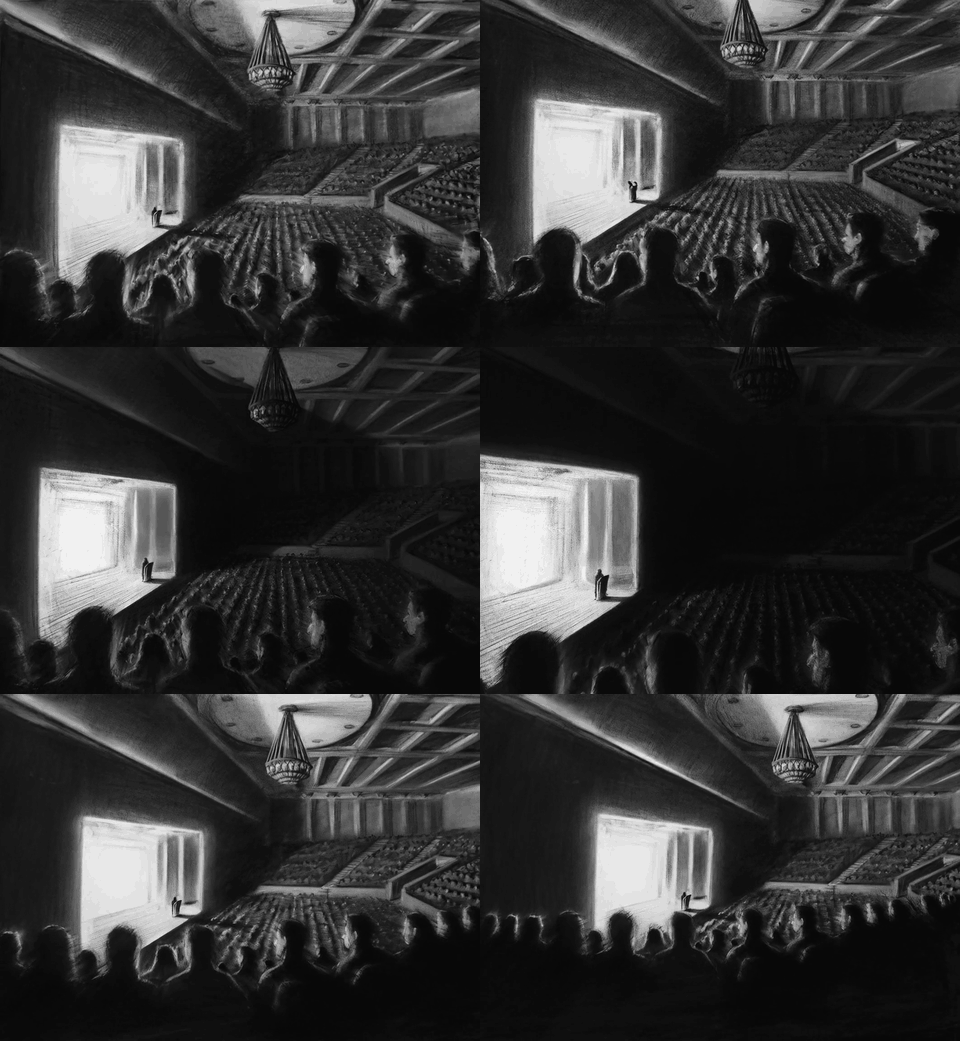
His lecture ran for an hour, followed by a fireside interview. The content of the lecture was dense, and enough has been written about it on the internet already that I won’t attempt to summarise Thiel’s entire talk here. I’ll focus instead on the points or strands that struck me as most important.
The first is that, to understand the Antichrist, you need to understand the Antichrist’s relationship to Armageddon — the final battle between good and evil prophesised to take place before the end of days. Thiel used Biblical prophecy as a framework for examining the very real extinction-level, Armageddon risks posed by modern technology. These technologies had not been imagined let alone invented in medieval times when religious fervour (and violence) was high, and the risk of civilisational man-made apocalypse was unimaginable. Those technologies, specifically, are: nuclear weapons, artificial intelligence and bioweapons.
But alongside these technologies potent enough to manifest Armageddon, Thiel identified one more apocalyptic risk: the risk of the Antichrist. The Antichrist represented a different kind of risk – the risk of humanity falling under a dystopian one-world government. He singled out the Effective Altruism movement, whose adherents are so concerned by the possibility of human extinction brought about by technology that they lobby to halt technological progress altogether through regulatory arrest. Thiel outlined the nature of the Orwellian risk of the Antichrist who rises precisely out of the stagnation that follows a period of unprecedented fear-mongering and subsequent suppression of technological progress. The Antichrist will be one who will use the honeyed words of “peace” and “safety” to induce a kind of mass hypnosis, playing on humanity’s fears to institute a technocratic one-world government, placing himself at its helm.
At this juncture, I want to bring in my own analogy from Greek mythology. Prometheus, the titan, stole fire from the gods and gifted it to the humans. But fire belonged to the gods, and human beings were not equipped to handle its power. The gods punished Prometheus by chaining him to a lofty crag and had an eagle tear out his entrails. Let us call this the “Prometheus Trap”.
By analogy, the fire Prometheus gave humanity would correspond to something like nuclear power or artificial intelligence in today’s world – powerful technologies that could easily be used to destroy ourselves should we fail to handle them wisely. The Prometheus Trap is the mythological Greek Armageddon. Thiel framed the entire first lecture around the need to consider both risks simultaneously: the danger of unchecked technological progress, as well as the danger of reacting with hysteria to technology, suppressing it, and dragging humanity into stagnation, into the arms of the Antichrist.
As for the identity of the Antichrist, Thiel said it could be a single individual and/or a system. That made me wonder whether the Antichrist might already be here with us.
Harking back to COVID in the year 2020, Anthony Fauci, then head of the National Institute of Allergy and Infectious Diseases, strikes me as having been a kind of Antichrist. He frequently invoked the need for “safety” and used it as a ploy to institute what I regard as having been a profoundly dystopian lockdown on the population. Listen to the Scientists and you shall be safe!! – the saying went. The disproportionate price of that safety was that people couldn’t leave their homes or do anything. They could only sit in the safety of their homes while time and life passed them by.
By 2026, Fauci had left the stage, but Trump 2.0 had arrived in its place. Trump 2.0 often talks of “peace” in the realm of geopolitics, but it is difficult to ignore the fact that war is spreading and global tensions are increasing. An unjust peace is the harbinger of lawlessness, of a world where the strong devours the weak. Such a world may already be unfolding in Ukraine and across the Middle East.
Perhaps the Antichrist is not only a single person but a system also, with a series of Antichrist figures taking turns at its helm. And while the individual at the top of that system plays the Antichrist, another figure – a transcendent master puppeteer – may be pulling the strings behind him. If so, what follows the Antichrist would be the Second Coming of Jesus Christ and the Day of Judgment.
Lecture 2: Katechon — The Force That Holds the Antichrist Back
Because the round trip from Atlanta to Nashville took eight hours, Heaven sensibly suggested we book an AirBnB for the night before, so we could take our time and make a proper two-day date of it.
For the second lecture, we booked a cabin somewhere in the Tennessee forest. It rained throughout the day on Sunday, but by night, the sky had cleared completely, and it was warm enough to just wear a T-shirt. The cabin had a nice little fire pit next to it. We built a big fire and it was so comfortable. We stayed up all night talking about the Antichrist, as well as the five months of our relationship, cooking steaks over the fire before returning to our cabin for sleep.
The topic of the second lecture was the Katechon. The last resisting force standing between humanity and the arrival of the Antichrist. Thiel explained that the Katechon might be a healthy, superintending power like the Roman Empire – something that holds lawlessness in check and prevents disorder from spreading.
This lecture was considerably more technical than anything I had hitherto seen from Thiel, and it was hard to follow. Fortunately, I had read the essay he and Sam Wolfe had co-written earlier in the year, so I was already familiar with some of the material.
Japan was mentioned. Eiichiro Oda, the creator of One Piece, was discussed. Thiel’s observation was that One Piece contained in it characters redolent of the “Whore of Babylon” and the “Beast of the Sea” – figures prophesied in Revelation, the final book of the Bible. A technologically advanced Western civilisation, built on the Enlightenment * that has all but forgotten its Christian roots, he argued, was receiving an important reminder from Japan.
* The Enlightenment is an extant period of time where European Christians stopped asking fundamental religious questions that begot sacred violence and focussed on progress in the real world.
The concept of the Katechon connects directly to our present moment. Russian philosopher Alexander Dugin, who is extremely close to the Kremlin, argues that the forces trying to spread corrupt, Satanic immorality across the world — LGBT ideology and everything that comes with it — are embodied in America and the wider West. In Dugin’s framework, ours is the true kingdom of the Antichrist.
Therefore, to Dugin, the Katechon or the last force holding the Antichrist back, is Putin’s Russia, or the “Third Rome”. This is why, in Dugin’s view, raining missiles down daily on Ukraine, a brotherly nation to Russia that dared turn its head towards the West, is something that ought to be celebrated. The Russo-Ukraine war has the flavour of Cain murdering Abel to possess his brother’s land. A force of evil that pretends it works for good.
Dugin’s framing of Russia standing alone against the satanic West is one that is promulgated by many an online troll, and whilst his criticisms of Western values do have some biblical basis to them, it is important to note that the personal freedoms enjoyed by citizens of Western countries, be they for LGBT persons or otherwise – are just that: freedoms. Dugin hates the freedoms we enjoy in our societies, pointing towards relatively minor sins that such freedoms given to man indulge in. The free man is a beast, without morals. Dugin would like to see that freedom destroyed. And so, perhaps Putin’s Russia is not the Katechon but rather the Antichrist itself.
Such framing is naturally confusing – with the pot calling the kettle black and vice versa.
***
On the long drive back to Atlanta, Heaven told me she had finally finished reading the Eurasian Odyssey trilogy. She gave me her heartfelt feedback:
“I’ve read all your books. One pattern I’ve noticed is that you almost always pose questions at the end of your passages. Sometimes to yourself, sometimes to your audience. They are often moral questions, and at times, they reveal a side of you that is extremely hard on yourself.”
She continued:
“Almost everyone American I know is scared to speak the truth. By publishing your own books on how you challenged the world during COVID by riding across the world, sticking your middle fingers up and saying COVID is fake, it takes balls. But it’s free speech, it’s individualist, which are our inalienable American values. I know you are not really from here, but you are more American than almost all Americans I know.”
Lecture 3: Architecture of the Antichrist
The third lecture started off with talk of money. By now, the 500-strong crowd that had filled the auditorium had dwindled to about half its original size. Heaven herself had started to give in to the tedium. It seems that modern people have short attention spans, whether they are Thiel enthusiasts or not. It is ironic that in a lecture series about the end of the world, the audience steadily thins out. Such important matters require sustained attention, one that should even intensify towards the end.
In this third lecture, Thiel talked about how the financial architecture built primarily by the US had extended itself globally, invoking the passage in Revelation about the mark of the beast restricting free trade to those aligned with the Antichrist. This, he suggested, was the Antichrist’s architecture.
The architecture of the Antichrist is something akin to the temple of a false god. In real-world terms, the digital technologies that have streamlined and fundamentally altered the way we live our lives – be they digital banking, search engines, or e-commerce – have also provided governments with the necessary tools for monitoring and control on a global scale. That would make it potentially one of the pillars in the temple of the Antichrist. The danger now, as Thiel remarked, was that the architecture has been put in place for the Antichrist-in-waiting to take the helm and bring all of humanity under his control.
This interpretation of modern information technologies is broadly in line with what I have long thought of as the logical conclusion of the theory that politics is always shaped by the technologies of its time. For example, in the days of Martin Luther, the printing press enabled a more decentralised form of religious and political authority by allowing information and knowledge to spread beyond the control of established institutions. One consequence of that technology was the Reformation and the eventual schism of Western Christianity. Similarly, nuclear technology was put on display in Hiroshima and Nagasaki, ushering in a new geopolitical age of Pax Americana, characterised by distant proxy wars, with great powers avoiding all-out confrontation with one another. The question now is: what is the logical political outcome of all the digital technologies that have been developed since the invention of the internet? Thiel seems to think that these technologies, and AI in particular, have a far more centralising than decentralising effect (he cites the iron-clad control of the Chinese Communist Party as the epitome of digital authoritarianism). In other words, these technologies represent ideal tools for governments – and for any Antichrist figure at their head – to consolidate power and authority.
This is all logical and sensible, but the most interesting thing Thiel said during his third lecture came at the very end:
“Perhaps an individual can at some point sit at the top and command this vast structure. If Christianity is slowly abolishing or at least undermining the scapegoating then maybe the logical conclusion of Christian history is that once scapegoating has been fully undermined, the Antichrist can rise to power because nobody will be able to stop them or denounce them.”
Thiel was drawing on the thought of his mentor, René Girard, in his closing remark. I have not yet discussed how important Girard is to Thiel’s worldview, but, broadly speaking, Girardian thought holds that human beings are driven by mimesis: we imitate one another. We copy each other’s language and fashion, and even our desires. Our capacity for imitation is one of the defining features of human beings, but Girard believed that this mimetic nature also leads us to conflict, potentially escalating into all-out violence.
The pagan solution to mimetic violence was scapegoating. This is essentially how playground bullying works. The bully picks on a victim, and nobody stands up for that victim because doing so risks making them the next target. Instead, other children join in the bullying because it keeps them safe from the bully and allows them to participate in the collective persecution of one who has become an acceptable target to the collective. Was bullying a kind of public service? At least it seemed like it to me when I was a schoolboy in Japan. The collective achieves a temporary unity by turning against a common enemy: the scapegoat.
The Christian response, at least in principle, is to expose the injustice of this mechanism: adults intervene, identify the victim’s innocence, and scold the bully. But the underlying dynamics of mimetic violence do not simply disappear. The bullying may continue, even as the victim grows into adulthood. The scapegoat is still sacrificed; the innocent victim is still crucified.
In Christianity, Christ was the ultimate scapegoat, and Christianity became the religion that exposed the innocence of the victim and the violence at the heart of human nature. But this unveiling of the scapegoating mechanism also threatens to undermine its effectiveness. Once people recognise the innocence of the victim, it becomes harder to unite a community by blaming and sacrificing that victim. Girard believed that the progressive exposure of this mechanism could ultimately leave humanity facing the prospect of all-out violence, without the old means of containing it.
After the third lecture was over, we drove back to Atlanta where I opened an old essay Thiel had written nearly twenty years earlier, The Straussian Moment. It is essential reading. I was struck by how consistent his views had remained over time, and by how much these Antichrist lectures seemed to extend the ideas laid out in that seminal essay. I read it once again, for the fourth time.
The Straussian Moment deals with esotericism: the practice of reading between the lines to uncover hidden messages in texts written with a double purpose. Such texts communicate unspeakable truths to intelligent readers – philosophers, in particular – without alerting less perceptive readers or government censors.
My own esoteric reading of The Straussian Moment was that Thiel did not believe Christianity, at least in its current Enlightenment-shaped form, had what it takes to work or to survive. Its logical conclusion, I thought, was apocalypse – a word that means “unveiling” or “revelation” in Greek, the disclosure of hidden knowledge, divine mysteries, or truths not previously known. That was my conclusion the third time I read The Straussian Moment. And so, Thiel’s closing statement in his third lecture, with its reference to the “logical conclusion of Christian history”, struck me as particularly significant.
Many people think that Thiel is the Antichrist. Maybe he is, given his power and influence as kingmaker, as well as his (very successful) history of investing in the very technologies that could enable the sort of Antichrist state apparatus he describes. But my own interpretation of what Thiel is attempting to achieve with these lectures is that he wanted to revive Christianity in the modern world. The Christian’s mission is not to give in to the Antichrist, nor to resign themselves to a predetermined course of history or the fulfilment of a supposedly inevitable prophecy. It is to find a path forward that reconciles Enlightenment rationality with the religious fervour the Enlightenment suppressed. To fight the Antichrist, to stand up to God’s plan, in essence, was what was required of us in our apocalyptic times. In that sense, these lectures provide ample advice in how to shape our own paths. In the first lecture, Thiel mentioned “courage” as the human quality most lacking and needed today. That, if anything, has to be true.
Lecture 4: The End
She left me. She fucking left me.
Right on cue to face the final rendition of the Antichrist lecture series, alone.
Truthfully, Heaven had been under immense pressure. This series of “dates” of ours in Nashville and Tennessee maybe was the straw that broke the camel’s back. Heaven is a single mother of 3, with 3 different fathers for each of her sons, of whom none help her with any kind of support, financial or otherwise. Her work is dancing for tips. The US economy was already in an unstable state as it is, with so much riding on petrol prices as our beloved Trump 2.0 “Antichrist” peace-prize candidate fumbles our country’s way into yet another impasse, a terrifying uncertainty loomed over the average American’s head, not least my own lover’s.
She’s the Christian sort of the Bible Belt, in a constant uphill struggle to reconcile her growing spiritual, Christian needs with the reality of her life as an ATL dancer, working graveyard shifts in this degenerating City of Sin – the same city that gave us Martin Luther King. His dream of racial harmony that has, since his assassination, descended into a divisive cultural war of endless, pointless identity politics.
Things came to a head one day when Heaven exploded in anger, leaving me to go to Nashville, alone. I took the Greyhound bus.
Nashville seemed empty without her. In previous weeks, we would walk the streets together, looking through the windows into the neat, polished, nu-age restaurants, waiting for Peter Thiel’s lecture to start. After the lectures, I would take her for oysters, for cocktails. All of that happiness was because we came here together. Now, the city seemed devoid of energy. Maybe it was just me. Heaven’s abrupt exit from my life had left in its place a gigantic void.
The auditorium was filled to the brim for the final lecture. I guess the urgency and hunger for learning returned just in time for Thiel to finally reveal just who he thinks the Antichrist might be.
Well, those hoping for a great apocalypsis (or unveiling) will have been mildly disappointed, for there was to be none. The ending to the lectures of the Antichrist was anticlimactic, with Thiel speaking at great length of the protagonistic role of the USA as the true, New Rome – all-powerful as the natural inheritor of the Roman Empire – but with a far greater, more comprehensive global reach than the British Empire, far wealthier than the Russians, and ideologically light years ahead of the Chinese.
Thiel proposed his 3-part qualifying test for the New Rome. The New Rome must be a:
- Military superpower
- Economic superpower
- Ideological or Religious superpower
Interestingly, Thiel lumped ideology and religiosity together for the third test. Why? The two are not the same; ideology is a matter of the mind, whilst religion is a question for the heart. Perhaps, it was this duality of the third test that also determined whether the New Rome performed as a Katechon – holding back the arrival of the Antichrist, or whether the New Rome itself would serve as the throne to the Antichrist. To that end, Thiel said that: if America falls, the West will fall, humanity will fall, and the Antichrist will take over America. He was quite adamant of America taking the centre stage of history henceforward.
After the lecture ended, an after-party took place down the street in the bar strip of Nashville. Cowboys and cowgirls were about, and loud music was blaring. The lecture organizers had booked out the entire second floor of Kid Rock’s bar for the closing after-party, but it was a veritable sausage-fest. I stood in the corner of the room, eating canapés, when a man wearing a MAGA hat approached.
“J” had a wife and six kids at home. He lived in the countryside in Tennessee. When his wife learned that Thiel was gay, she prohibited J from attending the lectures! He missed the first three, but attended the fourth because he was in town and free. Not because he is curious about gays, but because he was interested in what a smart person has to say about the Antichrist.
Well, we talked about Charlie Kirk. J said that Kirk had been “martyred”. I told him that he couldn’t have been martyred, because he was a youtuber, and that martyrdom was reserved for people who fought wars – who go to do battle and kill enemies of God. Then, we talked about Thiel:
J: “In the Q & A, I wanted to ask Thiel how he reconciles being in sin with his sexuality and being a public leader, especially on a Christian matter.”
Julian: “Take a look around this room. There must be 100 men in here. Show me – point him out – who here is free of sin in this room?”
J smirked a little impishly. Our discussion was interesting. I laughed and told him his points reminded me of my girlfriend who couldn’t make it tonight, but who had attended the first three lectures by my side.
J spoke of God first, family second, and country third. He spoke of the need for Christians to really practice the Bible.
Julian: “So… Do you truly understand the Scriptures? Because much of it is mysterious and difficult to imagine.”
Thiel is actually probably the only person outside of the Christian establishment talking up the Bible with such urgency and depth of interpretation. The fact that he connects the texts to things we are observing in society today with such detail and clarity, throwing Bible verses and quotes off the top of his head, demonstrates his level of understanding of the Bible.
(I remembered how Heaven couldn’t even tell me what the third commandment was, when we were discussing Israel and the oxymoron that is Zionism.)
I told J that it was a cheap shot to check Thiel on his sexuality – an ad hominem.
Even though J and I had different views on things, it was an amicable conversation, and we agreed on many points, and we learned from each other, which was great.
Then we shook hands and I started to leave to catch my Greyhound. He then put his hand on a copy of the Bible on the table. He had brought it with him! Just like Heaven had brought her pocket-sized Bible, and how I brought my Bible – the Russian one – gifted to me by Vania, the Ukrainian soldier who had been martyred in the fight against the Russians!
***
The entire series of lectures seemed to come to a head in that moment, in that corner of the room in the after-party; my initial dream to pitch Peter Thiel on my books, my meeting with Heaven and our subsequent separation, and then this conversation with J – all of these seemingly discrete threads seemed exquisitely interwoven into a coherent tapestry of my time in America, or as Thiel told it: the New and Final Rome.
The unfulfilled desire of the God-fearing American for not only a better society, but a Christian society, seemed to call out to me.
I hearkened back to an epiphanic moment I experienced in India, 2 years ago, on the Odyssey. In Varanasi, late at night, on the ghats of the River Ganges. There I sat reading the Bhagavad Gita each night, away from the tourist masses, while the pilgrims and the thieves slept. It read: “It is good to wash in the Holy River Ganga, but even better for you to meet and associate with those who, like yourself, also came to the Holy River, to talk with them, to learn from them”.
That was back in 2024. I subsequently met there a beautiful mendicant and served her for a week, carrying her bags and cooking Hindu food for her. Now, I found myself in Nashville. Here, there is no Holy River, but, inexplicably, here was a place where people – people interested in religion – congregated for the epic Antichrist lectures. And those sage words contained in Vedic text from India rang true in America too. It had been great attending Thiel’s lectures on the Antichrist; but even better to associate with and learn from those who also came.
Here too was a yearning for spiritual discovery – for a life better in alignment with God’s word. A yearning even stronger than the mighty flow of the Ganges, Christians gathered in Nashville to hear a billionaire homosexual expertly interpret and paint a picture of the impending apocalypse or the coming reign of the Antichrist – unless we, as a people, find a third way between two desperately negative outcomes.
The single greatest discovery I made in this series of lectures was seeing first-hand the spiritual yearning of the Americans. This finding came to me gradually through my association with Heaven, coming to a head at the final lecture after she had left me. I resolved to take action through courage. In Thiel’s closing remark, he emphasised the need to strengthen our relationships with one another in these apocalyptic times. I decided to write Heaven a letter.
In it, I would make the ultimate commitment. Not a marriage proposal, but an acknowledgment of her Christian faith, and my commitment to walk the Christian path with her. It was a conversion – not from anything in particular – but a conversion to. Well, that isn’t a conversion, but a commitment. It was a third way. Neither Armageddon or Antichrist, but a choice for Christ. A choice for Heaven, not Hell. It was the just, fitting and logical conclusion to the Antichrist lectures.
It worked.
Thanks for the inspiration, Peter Thiel.