
Blue Zone of Sardinia
(Marvellous Sardinian sheep grazing at night)
In this post, I introduce the so-called “Blue Zone” of Sardinia, based on an investigation I conducted on the island of Sardinia, Italy, in the heart of the Mediterranean Sea.
What are Blue Zones?
Blue Zones are five regions in the world where people are known to live exceptionally long lives (often beyond 100 years). Research on Blue Zones focus on positive lifestyle habits rather than genetics and seek to understand why residents enjoy such longevity.
The five Blue Zones are:
- Ogliastra region, Sardinia
- Ikaria Island, Greece (Aegean Sea)
- Okinawa Prefecture, Japan (the whole prefecture!)
- Nicoya Peninsula, Costa Rica
- Loma Linda, California, USA
Of these five, Sardinia is the one I know best through my travels across the world in the Eurasian Odyssey. In addition to knowledge I already possessed, this report reflects what I observed during a four-day excursion into the mountainous Ogliastra region in southeastern Sardinia.
I was joined for this excursion by Nastasya Filippovna (NF), a woman of Russian descent who appears in my books. She herself originally came to Sardinia as a traveler curious about the Blue Zone, so she made the perfect foil for this report. I decided to investigate partly through her perspective to get a genuine “user perspective”. Personally-speaking, I am not particularly into health or longevity, so I never understood the fascination with Blue Zones. However, NF’s own journey became the catalyst for meaningful research.
The Blue Zone concept is now relatively well known in Italy and has even been featured in domestic travel documentaries. Outside of Italy, however, quality information is quite scarce, and the idea remains somewhat niche—almost like an urban myth. As a result, “Blue Zone tourism” has emerged, catering to this niche market. Yet such tourism often emphasizes packaged experiences over the real factors linked to longevity. The line between authentic secrets of longevity and their commercialization has blurred.
Since NF and I both speak Italian (her much more than me), we chose to approach the Blue Zone not as tourists but as simple observers of daily life, hoping for a more faithful form of research.
Structure of the Report
- My own observations
- NF’s travel diary
- My commentary on NF’s diary
This format allows us to compare overlapping and divergent impressions, hopefully bringing us closer to the truth about the Blue Zone.
In part ③, I explore NF’s personal background to better understand the kind of people who seek out Blue Zones and the social context behind it.
The Environment of Sardinia
Sardinia is an island that lies between Spain and Italy, just south of the French island of Corsica. The island is mountainous, with elevations of 700–1,200 meters, interspersed with plains in the central and southern regions. Many ancient volcanoes are scattered across the landscape.
One of Sardinia’s defining environmental features is wind. Powerful Mediterranean air currents frequently sweep across the island. Summers bring intense heat—less humid than Japan’s but increasingly hotter in recent years. The greatest local concern regarding climate change is drought. Though desertification has not occurred, agriculture dominates the island’s economy, and droughts reduce grape harvests (for wine), autumn olives, and winter livestock pasture. Since agriculture supports both the island’s self-sufficiency and surpluses, drought directly impacts people’s lives.
Economically, Sardinia is far less developed than the other major Italian island of Sicily. Sicily’s forests have largely disappeared, converted into farmland, while Sardinia remains heavily forested. This lack of development means much of its natural environment remains blissfully intact.
Lifestyle in Sardinia
Sardinia’s two main (or only) industries are tourism and agriculture. Cagliari in the south is the only major city; elsewhere the island is dotted with small towns and rural villages. This report focuses on life in the latter.
As in mainland Italy, every rural village has several bars. With the exception of housewives, nearly all residents—young and old, men and women—visit these bars, read the newspaper, drink coffee, and converse before starting their day. Community spirit is a defining feature of Blue Zones worldwide, whether in the Seventh-day Adventist community of Loma Linda or Okinawa’s moai or もあい (friendship and mutual aid groups). Community is seen as one of the secrets to a long and fruitful life. In Sardinia, these bars play their part.
The main form of agriculture is sheep farming for dairy purposes. Some shepherds are traditional herders, while others sell milk wholesale to established cheese factories. Sardinian cheese production falls into two categories:
- Industriale: large-scale, factory-produced cheeses sold commercially
- Fatto in campagna/casa (FIC): “made in the countryside/home”
FIC cheeses, often made from raw milk, are consumed locally rather than sold commercially (owing to EU food-safety rules). These are considered the most authentic. Left at room temperature, they can even develop maggots—a natural sign of living microorganisms. While outsiders might recoil, others see it as proof of authenticity–that the cheese is indeed “alive”. That said, FIC cheeses are mostly eaten by older generations; younger Sardinians prefer modern tastes such as pizza made with industrial cheeses.
This shift in preferences from traditional FIC to industrial products reflects the erosion of Sardinia’s food culture, driven by scientific “food safety” education, supermarket advertising, and the financial dominance of major brands in industry.
Agriculture, Hunting, and Community
Life in Sardinia marries one to his environment. Many Sardinians own large tracts of land and rely on neighbours for help with labor-intensive tasks such as olive or grape harvests. These activities require stamina, patience, and time but yield little profit, even for high-quality produce.
Wild boar hunting is another community practice. Licensed men gather each Sunday to hunt, returning with boars strapped to their car bumpers, honking as they triumphantly re-enter the village. Boars are considered pests for destroying farmland, so hunting also supports rural life.
Without community cooperation, these tasks would be nearly impossible—paralleling Japan’s old village systems that use ostracisation as a punishment mechanism to promote harmony within the community.
In my view, however, the most important factor preserving Sardinia’s Blue Zone lies in its geographical isolation. Mainland Italy is crisscrossed with roads, all ultimately leading to Rome. There’s even an English saying: “All roads lead to Rome”. Not in Sardinia, however! Sardinia, by contrast, is over 400 km away, reachable only by ferry or plane. Even reaching Cagliari, the island’s only major city, requires long travel from rural villages. This isolation has preserved traditional customs, limited outside influence, and arguably fostered lifestyle habits that promote longevity.
Culture, Choice, and Longevity
Proximity to large cities offers freedom—but freedom doesn’t always result in good choices. In Japan, for example, many young people abandon village life for Tokyo, adopting a very different, comfortable lifestyle. Sardinia’s isolation reduces such choices, preserving its culture of strong community ties.
Proof of this is seen in marriage customs: nearly all of my elderly Sardinian friends are married to their childhood sweethearts. First love equals life partner—unthinkable in much of today’s world, but perhaps a cultural factor that promotes health, happiness, and longevity.
My Connection to Sardinia
I have a long personal relationship with Sardinia. I first visited in 2020 during Corona, initially staying for one week to cycle through; returning again in 2021 for a month and a half; in 2022 for half a year; and in 2024 for two months. Suffice to say–I met a girl. Initially, though, I fell in love with the olive oil here–the greatest in the world, returning yearly to join the olive harvest.
Living in Sardinia physically transforms the body through daily labor.
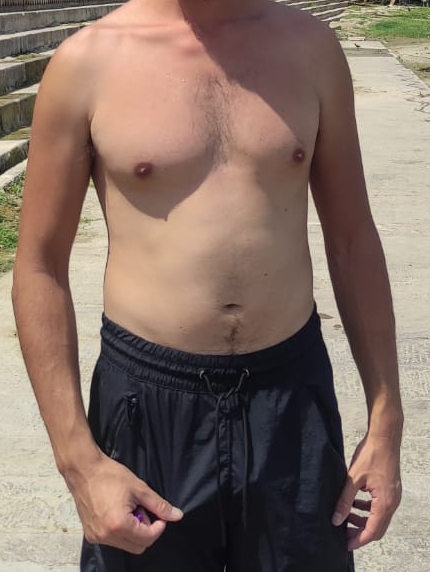
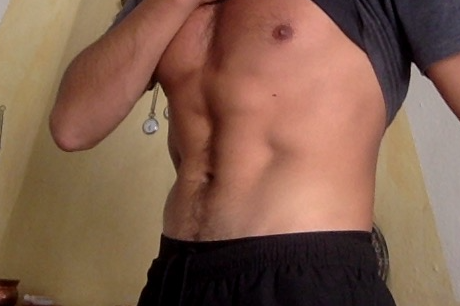
(Sardinian body (35 years old) harvesting olives versus Hindu diet body (37 years old) crossing India by bicycle
For instance, my usual weight is 82–84 kg (181–185 pounds).
But after a month of olive harvesting in 2022, I slimmed down to 78 kg and felt noticeably stronger and more toned.
One of the defining characteristics of life in Sardinia is how quickly time passes. I had originally planned to stay from November 2024 through January 2025, yet the days seemed to slip by without pressure or urgency. There was nothing I had to do, apart from the natural rhythm of harvesting olives and spending time with friends.
A friend I met during the olive harvest owned several vacant houses and large plots of land, and let me stay in a spacious, comfortable house without paying a single cent in rent. Each day was guided by nature and the weather: deciding whether or not to visit a hot spring, whether to help tidy a friend’s field, or what to cook for dinner. Beyond the weather, there was little else to think about. Days like these rolled on, and three months disappeared into the past in the blink of an eye.
Setting aside the “things achieved” in that time, isn’t this exactly what life was supposed to be like in the so-called “Golden Age” of Greek mythology? A life of ease, abundant food, and deep companionship, where time flowed in harmony with nature. Sardinia, after all, is often called Paradiso. Step outside and you are greeted by mandarin oranges and pomegranates in the garden. Want an apple? Just stop by a friend’s place. Together we would drink homemade wine (from grapes I helped to harvest the previous year) and spend long evenings laughing over light, meaningless stories. The Golden Age described by the ancients must have felt very much like this.
In comparison, city life is undeniably more exciting and efficient—better suited to making money. But the longer I stayed in the Sardinian countryside, the more I realised that city life distances us from reality. The clearest way to measure this is through is the price of goods—the monetary value attached to everything. In rural Sardinia, it feels as if “price” does not exist. If you have friends, barter (or rather, gift-giving) occurs naturally, and you live richly without ever thinking much about money. Pure wine, cheese, olive oil–all are so abundant that they are gifted.
So what, then, is “reality”? Is the city’s money-driven life closer to reality? Or is rural Sardinia’s nature-based life the truer form? At the minimum, I can say that living in rural Sardinia shields you from the capitalist system—advertising, wages, property rights, and the constant stress attached to ownership of something or other. As an example, when I returned to Tokyo I found myself often appalled: “This junk food is sold at such a high price?!?”
[Distance from Nature = Distance from Reality]
This formula could perhaps be expressed numerically, but I think “travel time” is a more accurate measure of distance than kilometers.
The Road Trip
In exchange for accompanying me on my excursion into the Blue Zone, I asked NF to write a short “report within a report”.
I added my own commentary here and there to her report, and in doing so aim to deepen the reader’s understanding of the “user perspective”, whilst weaving a broader story about modern life.
Exploring the Secret of Longevity
By Nastasya Filippovna
Living to 100 years and longer and being active at 80, 90 years old is not a fairy tale, but a reality. And who doesn’t want to live not just long, but also actively? So I, tired of the big city, decided to change my environment.
However, the story begins a bit earlier, in September 2018, when I first came to Sardinia – not just for vacation, but to explore. After the damp climate of Russia’s cultural capital, St. Petersburg, I found the sunny and vibrant atmosphere of Moldova, where I grew up, much more appealing.
NF is a Russian woman born in Moldova (ex-USSR). In the former Soviet Union, there were frequent relocations of citizens due to state policy. As a result, Moldova today is home to the indigenous Bessarabian people, as well as people relocated from other Soviet regions. So like many Russians, she has a connection between Moldova and mainland Russia.
After all, my body was already persistently demanding sun, juicy vegetables, sweet “non-plastic” fruits from the tree. My taste buds were asking for real homemade cheese and wine in a longing for the taste of life. My heart was thirsty for leisurely conversations with neighbours, with random passers-by. “Far from the indifferent bustle of big cities! To the sea! Higher, in the mountains! Closer to the land and to people!” I decided.
The criteria for choosing a place were clear: a warm climate, plenty of sunshine, high-quality homemade products like cheese, vegetables, butter, and wine, as well as the sea and mountains. ‘I wanted a lot!’ many would say, but I kept my thoughts to myself. And I found it! The choice of island was obvious; it offered all of that and much more. Initially, I focused my search on Italy. As I delved deeper online, I learned about the long-lived people residing in the so-called Blue Zones. So, I set off on a reconnaissance mission armed with just my suitcase.
My first landing was at a rocky spot near the Bastion in the heart of Cagliari. Tired from a challenging flight and still recovering from a recent cold, I savoured local cheese and wine in a courtyard surrounded by greenery. In that moment, I felt a spark of life, sensing that I had truly found my island. Sun-drenched Cagliari, with its lush green alleys and the vibrant atmosphere of a small town, reminded me of my hometown, Chișinău, while its palatial architecture echoed the grandeur of the Great City of St. Petersburg on the Neva River. On top of it all, the warm sea and cheese, infused with the essence of the Mediterranean air, created a perfect scene.
Upon returning to the northern capital of Russia, I was consumed by one question: ‘How can I return to Sardinia as soon as possible?’ That same evening, while sitting in my kitchen with its dreary view, I miraculously *found accommodation in a small village in central Sardinia. By the end of November, I was setting foot on the island once again. Despite the wind, the air felt warm and invigorating, revitalising my spirit. This trip proved to be transformative. **Although I had to give up a lot, my decision to stay on the island was unequivocal. In the end, I found that I gained much more than I lost.
* This village is the town of Nuraghia, which appears in the Eurasian Odyssey and has the best olive oil in the world. Here, NF was welcomed into Mr. Torre’s home, where she found her place and was able to experience the real Sardinian culture.
** NF herself has omitted from this part certain details because it is very personal. But as far as I know, “giving up a lot” is a very modest expression. In fact, NF pursued her dream of escaping Russia to Sardinia even if it meant leaving her husband, who had cancer, behind.
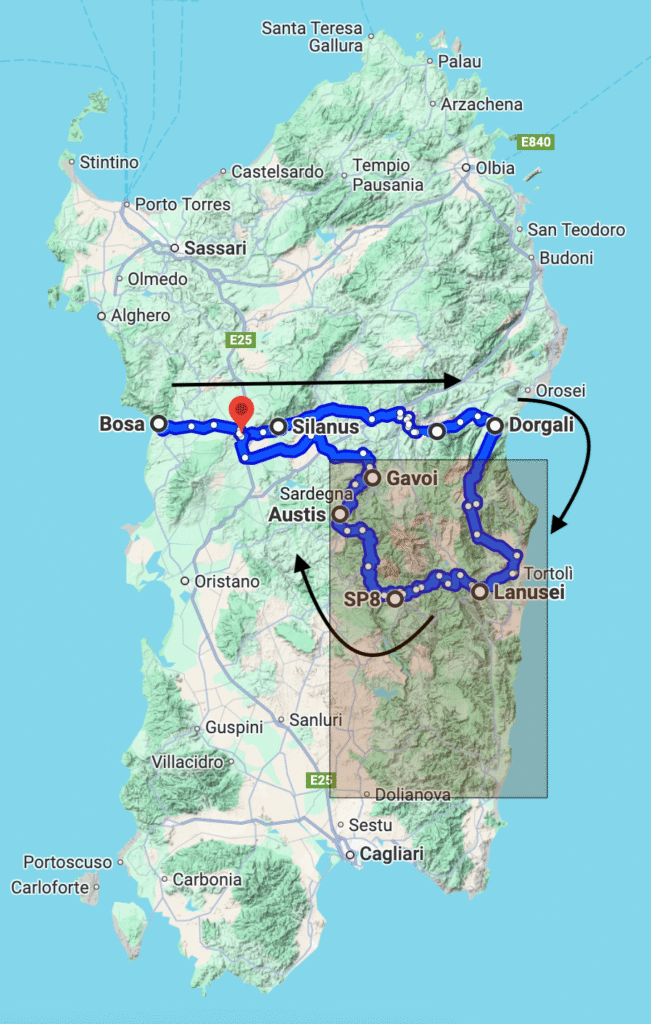
And this time, in the autumn of 2024, exactly six years later, a like-minded person was found, the car was filled with gas and we set off on a journey in search of a recipe for longevity across Sardinia. Our route started from the seaside town of Bosa through Macomer and into the depths and heights of the island. Off the road near Oliena, strolling through olive groves and vineyards, we accidentally, or rather, following the smell of freshly baked goods, wandered into the house of a retired pastry chef. The kitchen was full of jars of jam, freshly baked cookies of various shapes and pies. He made us coffee with spring water, treated us to homemade shortbread cookies and quince marmalade. Over coffee, Lussorio–that was his name–told us about his life, which was not at all devoid of adventures. Being a chef by profession, he had traveled half the world. His experience was evidenced by the collection of teacups in the kitchen. After retiring, he continued to “feed” others, namely, he began to bake sweets for the locals. We did not ask his age, but he looked about 80 years old, seemed to be without a family, and repeated more than once that he was happy.
Yours truly.
Before that, we had made a short stop at a farmhouse near Oliena, where we tried young goat cheese with tartufo (truffle) and ricotta with herbs. I remember the friendly young owner and the landscape design, where each corner was a separate story, maintaining harmony with nature.
We stopped for the night in a charming B&B between Lanusei and Ilbono, in a house where the owner, Maria, radiated happiness with her whole being. And you could easily understand her. The house is located in a picturesque area, among fruit trees with a panoramic view of the mountain ranges and the sea. We met her brother, an agronomist, from whom we bought homemade wine and olive oil. We went to his workshop, where he was experimenting making wines with different types of grapes, some of which were wild. In the morning, Maria, our hostess, prepared breakfast with fresh fruit, cheese, eggs and, of course, homemade pastries of various types. Maria has been welcoming guests into her home for 18 years now, having previously worked as a kindergarten teacher. “My husband and I have a large family, in which we have every profession, from an agronomist to a doctor and an architect,” the hostess said, almost dancing with happiness. Thank you, Maria!
In various parts of Italy, you can buy homemade wine, olive oil, cheese, etc. directly from producers. This is the most natural form of business, as the government is not involved in the transaction. Naturally, quality varies from place to place. In this respect, the wine, olive oil, and cheese in Ogliastra, a designated Blue Zone, were inferior to those of Nuraghia, where NF and I spend most of our time. Also, since long-lived people are found throughout the island–not only in Ogliastra–the tourist business aspect of the Blue Zones became more apparent.
From Lanusei, we stopped in the villages of Seui and Seulo, where we met a couple of long-livers in everyday traditional clothes, walking calmly and without sticks to the local market. We got to talking…
I hit my rental car against a wall here. It was a very old, small village, and I had to go through a narrow road that went under the railway line, and it was a slope of about 2 meters. I got the angle wrong, and I made a mistake in reversing the slope and scraped hard against the wall.
And then a serpentine road among mountains, orange-coloured forests and green slopes awaited us. The type of vegetation changed from hill to hill, as did the taste of spring water in the springs we encountered along the way. Water on Sardinia is worth a lot of gold, and the Sardinians treat it very carefully. Throughout the entire trip, we never bought water.
When you go to mountain areas, you will find springs everywhere. The mountain water flowing from each spring has a slightly different taste, so it is common to go to the spring to collect water for your home rather than spending money to buy it at the supermarket.
After spending the night in a cozy authentic house with a fireplace in Austis, we headed to Gavoi. And that was definitely the cherry on the cake. Apart from the friendly Tonino, the owner of the neighbourhood delicatessen, from whom we bought homemade aged pecorino cheese (from under the counter, literally), the view of the shimmering lake between the golden slopes of the mountains was magnificent. On the shore of a completely deserted peninsula jutting out onto the lake, we made our final stop, having a snack of the cheese and wine we bought.
The night was my birthday. NF and I have known each other for four years since the start of the Odyssey, and we have been through a lot in that time. Two years ago, she betrayed me, and after that, I remained in Sardinia for five months, facing many hardships, such as sleeping outdoors and not being able to speak the language at all. After that, I went to Ukraine. We remained friends, but I was suddenly blocked by NF. I did not expect to see her again, so this reunion was unplanned. Still, she came to me, so I went along with her, and eventually we embarked on this research trip, together.
Of course, I was hoping to have sex because it was my birthday, but before I went to bed, I got a call from a friend in Ukraine. “Julian, are you spending your birthday night with someone?” he asked.
“Sorry bro, I’m with a Russian girl,” I replied.
“Then I have just one request for you. When you do the deed, shout “Glory to Ukraine.” he said.
Because it was a video call, I could see my own face, and when I heard this call to arms, my eyes changed and went wild. I answered “Yes!” as if I was commanded.
At that moment, I remembered my friend “Vania” who lost his life in the Ukrainian war, and realized that I had to complete this mission no matter what, and even more so, to dedicate the moment of finally defeating the traitorous Russian woman to the glory of Ukraine. I decided to do it so that the hero in heaven would be proud when he looked down on me.
Sex that night was particularly intense. The co-author of this report lay prone, naked on the bed, and so I duly mounted her…
I thrust her between her legs so hard that I was crushing her mercilessly, ejaculating deep into her in an eruption of pleasure, hatred, fury and love. After catching my breath for about 30 seconds, I shouted loudly, “Слава Украине, Блядь!!” (translation: Glory to Ukraine, you whore!!!) while still on top of her.
At that moment, she laughed, but she did not permit sex the following morning, instead strongly scolding me: “A normal person would say that you love me, but instead you make a political statement right after fucking your girlfriend, I don’t understand!!”
“Girlfriend??” I retorted that that ship had sailed. I may have loved her once, and may still love her, but next to it coexists a great hatred of the bitter memory of betrayal. My Ukrainian friends may be stupid, but they are still my friends, and I certainly carried their hatred for Russia with me. And even in the middle of this remote area of the Sardinian Blue Zone, the fighting between Russia and Ukraine continues.
But behind that hatred was another emotion towards her. NF said that she came to Sardinia and the Blue Zone in search of a better life, but she previously shared some personal information with me. That is – she has problems with her hormones. In fact, she has never had a period while I knew her. Indeed, I had recently begun to wonder if her true problem was infertility, and her search for a healthier, fuller lifestyle belied a deeper problem requiring a radical solution.
I wanted to do whatever I could for her that night, and if I could give her life, I wanted to answer her dreams, desires and challenges for the Blue Zone.
What’s the secret?
The secret, or rather the recipe to a good life, according to our observations, is a combination of several factors/ingredients, namely:
- NATURE
The sun shines warmly on Sardinia almost every day, illuminating the mountains and forests, olive and cork groves, the sea, sandy and rocky beaches from white and pink to black and gold. And the Mediterranean air, saturated with the sweet smell of local herbs, which changes its tone from zone to zone.
- FOOD
“We eat what we grow or produce ourselves” – you can often hear at the table in the homes of long-livers. And they eat mainly vegetables, leaves and herbs, legumes, cheese, olive oil and bread, washing it down with a little red homemade wine. So, either stewed legumes with mint and milk, or herbal soups, or just bread, cheese and olive oil, which is included in almost all dishes on the island. In addition to high-quality food, we should also note their moderation in food. According to our observations, long-livers eat everything, including the famous roast pig on holidays, but in small quantities.
Many people who study nutritional science and follow Blue Zone diets claim that legumes or beans are a central part of their diet, but this is nonsense. In four years of coming to Sardinia, I saw locals eating beans maybe once.
- PHYSICAL ACTIVITY IN THE OUTDOORS
Life on the island is simple and natural compared to the mainland of Italy. Farmers, shepherds and cheese makers are still often found here. We personally know the younger generation of centenarians (those who live to over 100). For example, we have been helping two friends, or rather a godson and his godfather, to harvest olives in the village of Nuraghia for several seasons now. The older of them, at 78, works with a handheld machine called scuotitore during the harvest, similar to a long rake with a comb on the end of it, which vibrates, knocking the olives off the upper branches. For a couple of hours at a time without stop, with unbreakable calm, he holds the scuotitore upright with his arms raised. The younger one is over seventy and he “jumps” around the olive trees with a small chainsaw, cutting down old branches, and loads 25-kilogram boxes of olives into the car. In addition, our friends tend to a small vegetable garden and vineyard, make wine and cheese, and, of course, meet with friends for appetizers with a subtle sense of humor as a snack.
- COMMUNITY
Most long-livers have large families – siblings, cousins, children, nephews, grandchildren, etc. It is believed that communication and support from family members, communication with children and grandchildren is one of the main ingredients of the recipe for longevity. Unfortunately, we were unable to verify this during our short trip. But we were convinced that they walk hand in hand with their other half until their venerable age, as our friends do.
I don’t know if this is true. At least in our circle, there are three old men and one couple who have no family. In fact, I feel that there are a lot of families without children here.
Statistically speaking, Italy is in a particularly serious state among Western societies where depopulation is progressing. And we ourselves will be included in this statistic unless we do something.
That said, even if we disappear without leaving descendants, it will not have any affect on nature here. As a whole, the community can somehow survive through culture – which, ironically, is at even greater risk of being lost.
I personally don’t understand the pursuit of longevity. Even if you can integrate into a community that is more than a family, it doesn’t mean you can have a family or become one. I think the Blue Zone holds a stronger appeal for a hope that goes beyond individual aspirations. Whether we can actually meet that hope will depend on how we make use of this rich island.
SUMMARY
The flora and fauna of Sardinia that have retained their authenticity, simple cuisine made from natural, quality ingredients, moderate but constant physical activity in the fresh air and at home surrounded by relatives and friends while singing – isn’t this happiness and the secret of longevity?
My family’s reactions to my changes were mixed. Some of my close friends thought I wouldn’t dare go through with the move to Sardinia and that I wasn’t serious. My brother kept reminding me that there are warm places in Russia, along with cheese and the sea. My parents took it relatively calmly; at least they didn’t bombard me with questions. They didn’t have time, because I always put them before the fact of another trip or another important decision in my life. And they always trusted me. My friends found out after some time that I was visiting the island and living there part-time. They asked questions, supported me, and were surprised that I wasn’t afraid to make such a radical change in my life. I truly wasn’t afraid because I knew it was necessary. What was really frightening was the idea of remaining in that ‘false comfort’ in St. Petersburg and living someone else’s life.
In English, there is a concept called “Mid-life crisis.” NF is not the only foreign woman I met in Sardinia who wanted a life beyond participating in a competitive society. I met foreign women who came to Sardinia alone in unexpected places, such as AirBnBs in the countryside and at the beach in Bosa.
They were women in their 30s and 40s who held a deep unease and disapproval of modern capitalist society who found themselves alone in the great outdoors as a result of serious contemplation over their future. The standard of living has dropped significantly due to rising prices in big cities, and as smartworking becomes widespread, and information about Blue Zones gradually spreads from the corners of the Internet, the number of people who desire a return to the mythological “Golden Age”, like NF, will increase in the future. Ironically, this may actually be the great hope for Sardinia, and not only for individuals like NF who come here.
In the countryside of Italy, where the population is decreasing, there are many properties that can be purchased for 1 euro, and they are a hot topic on the Internet. It sounds too good to be true and, indeed, there are strings attached – e.g.: a €30,000 investment in the interior – but at the same time, it’s true that a solution to the problem of rural depopulation is being sought here too.
I had no doubts about Sardinia. The soft and warm Mediterranean wind on my face in December dispelled any fear of the upcoming adaptation. Doubts emerged later, but that’s a completely different story. Over the six years I’ve lived on the island, I’ve left many times but always returned to call it home. Who knows what will happen in a hundred years?
After all, longevity itself is intriguing not so much by its duration as by the quality of life, the activity in, so to speak, of old age. And on the eve of 2025, Sardinian centenarians at 90 meet with friends in a bar for morning coffee or a glass of wine at noon, shop at local markets, and at 80 years old, many of them are still quite active in their gardens, picking olives, tending to vineyards, making wine, baking homemade bread and local sweets, preparing cheese and much more, passing on secret recipes to an increasingly less interested younger generation.
There is a problem that young people in Sardinia are not interested in participating in nature-based activities centered on agriculture, which also functions to preserve their culture.
The reasons for the problem are: economic (part-time farming is not profitable), aspirational (young people want to achieve something) and, of course, there are more interesting options in the big cities far away. Will young people in Sardinia return to the fields like previous generations?
Only time will tell, but the prospects are not good. All the Sardinians we call friends are pensioners and receive a continuous source of income (800 euros per month), but young people need to find meaningful work (?). Such jobs are non-existent in Sardinia.
In other words, you need the desire to be in Sardinia, in the Blue Zone, even if it means foregoing the opportunity cost of a good job and ambition for success. In this respect, foreigners who commit themselves to the island, like NF, are in a sense pioneers and certainly people who deserve attention, admiration and respect.
***