
Blue Zone:Ikaria Island

In this report, I would like to introduce one of the Blue Zones — the Greek island of “Ikaria.”
Overview:
In the previous Blue Zone report, I introduced the Italian island of Sardinia. The conclusion of that report was that one of the major characteristics of Blue Zones is their isolation from big cities. Being far away from the capital, Rome, contributed to the development and preservation of Sardinia’s unique culture, and helped protect the island’s nature, food culture, and the quality of its agricultural products. Ikaria Island is similarly an isolated island, and similar conditions as Sardinia apply here.
The Greek mainland lies at the southern tip of the Balkan Peninsula, and Greece has more than 200 inhabited islands. Among them, Ikaria is especially far from any large city. The nearest large island is Samos, two hours to the east by ferry. Further to the east lies Turkey, but since Turkey is Greece’s historical enemy, there is little trade or exchange between the two, particularly in this quiet corner of the Aegean. Ikaria island is far from Greece’s capital Athens, as well as its second city of Thessaloniki (about 10 hours by ferry to Athens, and about 20 to Thessaloniki). So, Ikaria fulfills the key Blue Zone condition of geographical isolation.
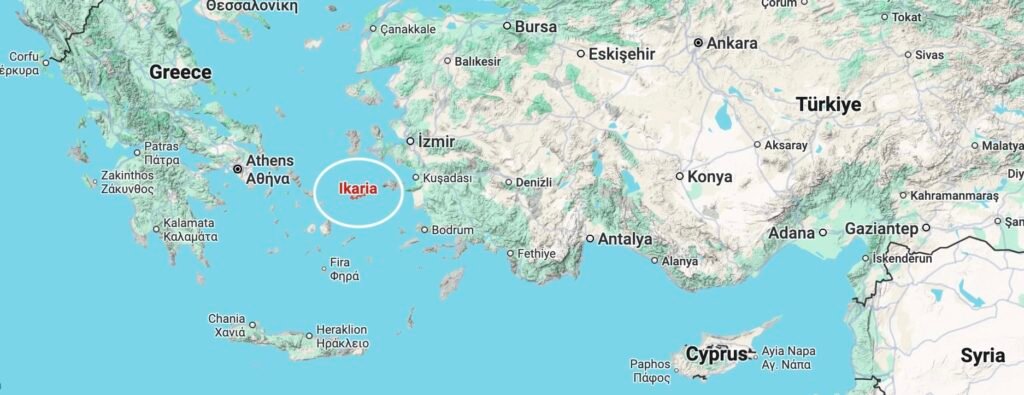
The main difference between Sardinia and Ikaria is the size of the island. Ikaria has only about 8,000 inhabitants. Sardinia, on the other hand, has 1.5 million. The area of Ikaria is also much, much smaller. What the two islands share are the essential elements of Mediterranean culture: homemade pure wine, olive oil, and cheese from grazing animals. In this respect, Ikaria’s wine is fundamentally pure (with absolutely no additives), and many households make their own homemade wine. Of course, since the environments differ, their taste is naturally different; Ikaria’s wine gave a brisker, fresher impression. This is probably because, in Ikaria, food and drink conservation methods did not appear very developed — or perhaps simply because Ikarians don’t try to preserve in the first place.
Meanwhile, in Sardinia, stores stocking equipment for preserving wine and olive oil (steel drums, tubes, glass decanters, etc.) can be found in every village, but in Ikaria, one hardly sees them. Likewise, there seems to be no heavy machinery for pressing olives on an island of only 8,000 people. As a result, in most cases, the olive oil in Ikaria quickly becomes oxidized, losing its rich aroma, and even the pure wines here are often served in bars in a considerably oxidized state. Of course, even if the wine is in the process of deterioration, it doesn’t necessarily mean that it’s no good – one can still enjoy its freshness and more natural taste — I have no complaint about that. In fact, I myself, after drinking Ikarian wine, was so overjoyed that I found myself dancing to traditional Greek music on the street, at least three times! In contrast, in Sardinia, people fret to preserve wine (transferring it to barrels or bottles in cellars to prevent oxidation), but on Ikaria there seems to be no such rush. Also, the cheese on Ikaria was mostly young, like feta. And so, I was left with the impression that Ikarians don’t care much about food preservation.
***
Journey to Ikaria
We, myself and “Nastasya Filippovna” (NF), who appeared in the other Blue Zone report for Sardinia, traveled from Istanbul, Turkey, to the Aegean coastal city of Kuşadası over two weeks by bus and other means, crossed from there to the Greek island of Samos, and then arrived on Ikaria by ship at night.
Immediately after disembarking, we rented a scooter for getting around. During the negotiation, I noticed that the people of Ikaria spoke at a remarkably relaxed pace. Slow speech, slow movements, slow driving, slow music. Another thing I’d like to mention is how Greece has excellent English education, and most young people can speak English at a globally high level. Apparently there is a culture of sending children to cram schools. When they spoke English, it felt as if they were choosing each word carefully and slowly. And during the 14 days we stayed on Ikaria, it felt as though time itself had slowed down.
After spending a few days on Ikaria, I noticed that I saw the same people in different spots, every day. That’s how small the island is — an environment where life resembles the old Japanese “village ostracism” (mura-hachibe), where one cannot escape the prying eyes of the village community. If you do something bad or get involved in a scandal here, word spreads throughout the island immediately. Indeed, in the two weeks I spent on Ikaria, I didn’t see a single police officer. This communal atmosphere also appeared during festival times.
Fortunately, the period when we visited Ikaria coincided with the Orthodox Christian Easter festival season, during which festivals and rituals were being held all over Greece. The islanders of Ikaria went into the crevices of the mountains to collect a special kind of thorny herb to pile up in the center of town, set them on fire, and launched fireworks. The herbs used for burning had peculiar shapes and burned so well that sparks rose high into the night sky, yet there was almost no smoke odor, and the clean smell of the smoke did not stick to clothing.
On the day before Easter, they slaughtered goats and hung them overnight in front of their doors to rest the meat. When Easter day came, they made homemade goat dishes. We were given a portion as a gift — a serving of goat meat and potatoes. The goat was a kid, probably weighing less than 15 kilograms. The meat was fresh; it was clear that it came from a goat that had been free-ranging on the mountain slopes of the north coast of Ikaria where we were staying. Lightly seasoned with salt, herbs (probably thyme), and garlic, it was very delicious — vivid, lively meat with almost no gamey smell. The potatoes were diced and sautéed with flour and olive oil. From the taste and texture, I could tell that the kid had eaten good herbs and had exercised plenty.
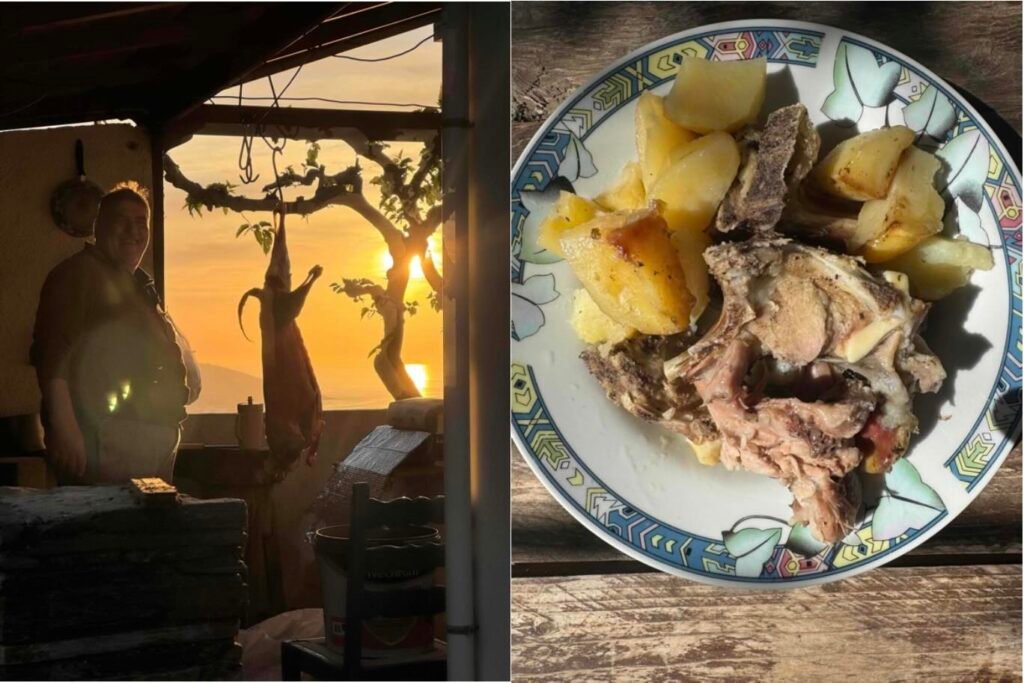
Right: The dish we were gifted)
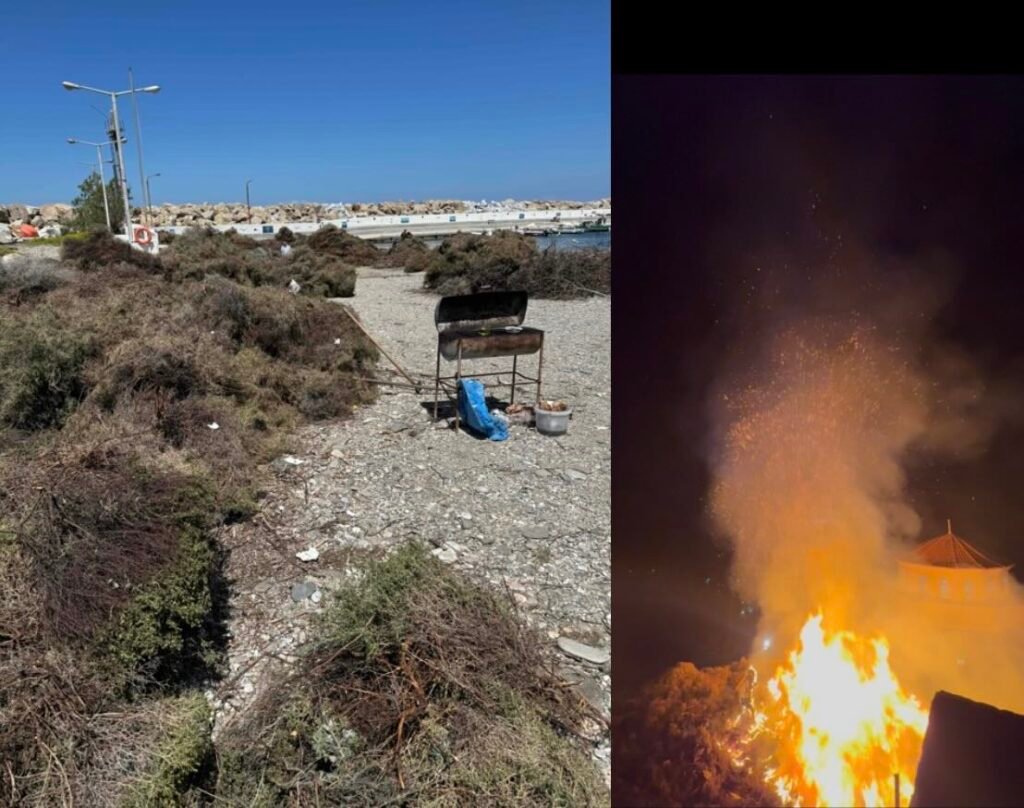
Right: Sparks flying into the night sky)
Outside of Easter, the general atmosphere on Ikaria Island was not very different from that of other Mediterranean cultures. People spent their days leisurely — drinking alcohol or coffee in the village square from noon, enjoying simple exchanges with family and friends.
In contrast, in Sardinia, sheep rather than goats are the main livestock, and meals are served communally, sometimes even for free during festivals. On Ikaria, however, Easter seemed to be a more private, family-centered event.
Itinerary
The first spot we visited in Ikaria was one of the island’s three natural hot springs. “Lefkada Hot Spring” is literally located on the southern coast. It was a type of hot spring I had never seen before. Instead of flowing along the shoreline, the hot spring water bubbled up directly from beneath the sea floor near the beach.
Swayed by the cold spring waves of the Aegean Sea, your body is irregularly warmed from below — from your buttocks, back, or the soles of your feet — by 50°C water spurting up from the sand, only to be instantly cooled again by the waves. Between the rocks and the surf, it feels as if the body is being gently stroked.
NF, overwhelmed by the heat of the water, let out: “Hot! Hot! Hot!” only to be instantly cooled again by the waves, clearly enjoying the time of her life.
Nearby, on rocks close to where the hot spring rose, we discovered a white substance that resembled salt. When I tasted it, it was indeed salt — but far stronger than commercial salt, with a burnt, almost toxic flavor.
A British man who was also bathing there warned me repeatedly: “This hot spring contains radon and is radioactive — don’t bathe for more than 20 minutes.” After about 30 minutes he angrily scolded me, and NF was exasperated by my refusal to acknowledge the fellow British tourist, so I reluctantly got out of the water.
Still, this mysterious hot spring experience was one any onsen lover ought to try at least once in their life. Perhaps because of the exposure to radiation, seawater, and strong sunlight, I became quite thirsty afterward and experienced mild dehydration.
In Sardinia, I bathed almost daily at the wonderful ancient hot spring of Fordongianus, but Ikaria’s springs felt more wild and elemental — a truly natural bathing experience. Though somewhat dirty, I collected as much of the natural salt as I could. During (and after) my stay on Ikaria, I became obsessed with the wild salt I gathered myself, and soon found commercial salt to taste far too weak.
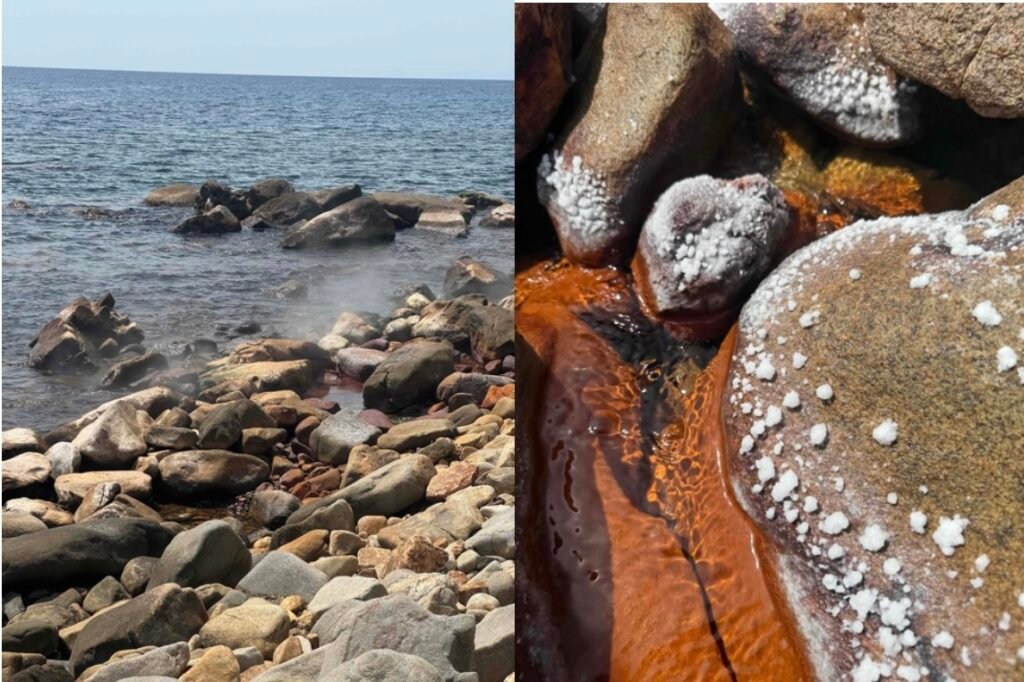
Right: Natural salt forming on discolored rocks)
In addition to the Lefkada Hot Spring, there is another natural hot spring located in the village of “Therma.” They share the same source, but the spring in Therma lies within a cove, where there are no waves, and the hot spring water rises from inside a shallow cave.
Crawling inside the cave, I found a dense accumulation of natural salt formed on walls of the cave, like snow.
Although I stayed in Ikaria for fourteen days, I went to the hot springs only twice. I wanted to match the rhythm of local life, and decided that going too often would detract from the process of natural observation of Ikarian life. Twice was enough.
Compared to the hot spring in Sardinia’s Fordongianus, Ikaria’s waters are rougher due to their radioactivity — not the kind of place to bathe every day — but soaking for about 20 minutes once a week felt good enough for the body.
Ikaria’s Special Herbs
Because the island is small and sparsely populated, it was difficult to compare Ikaria directly with Sardinia, another Blue Zone, and I couldn’t find any particularly innovative products besides some very gentle, handmade soaps and local Ikarian honey in the local goods store.
After spending several days quietly observing life on the island, I realized that the quantity of mountain herbs growing here was far greater than in any region I had visited before.
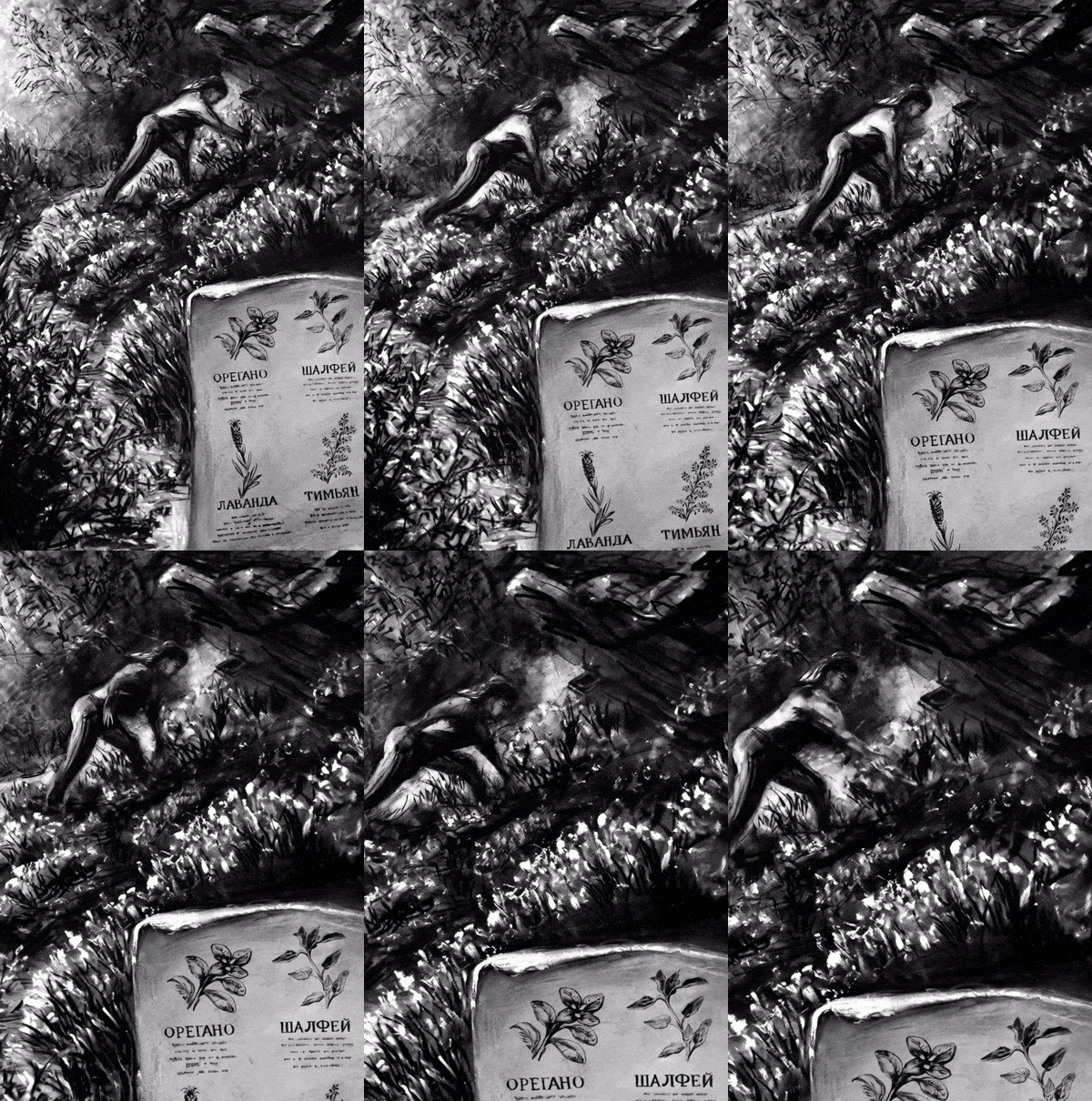
The most remarkable thing about Ikaria is its legendary herbs — praised since ancient Greek times. The island is richly covered with wild thyme (Throumbi), oregano, sage (Salvia), and lavender. The abundance of thyme especially surpasses that of any other region I’ve seen.
Although the locals did not seem to use these herbs much in either cooking or tea, elderly people collected them from the mountains, dried them, and kept them in their homes.
Bees, of course, are essential to the propagation of these herbs, and the herbs in turn sustain the bees. When we went into the valleys to collect sage, bees constantly buzzed around us, gathering nectar while pollinating the plants — and seemingly observing us, too.
We saw nomadic goats grazing on wild sage and oregano. In some valleys, the air inside the valley was filled with the fragrance of sage. I had never before encountered a place with such abundance of wild herbs.
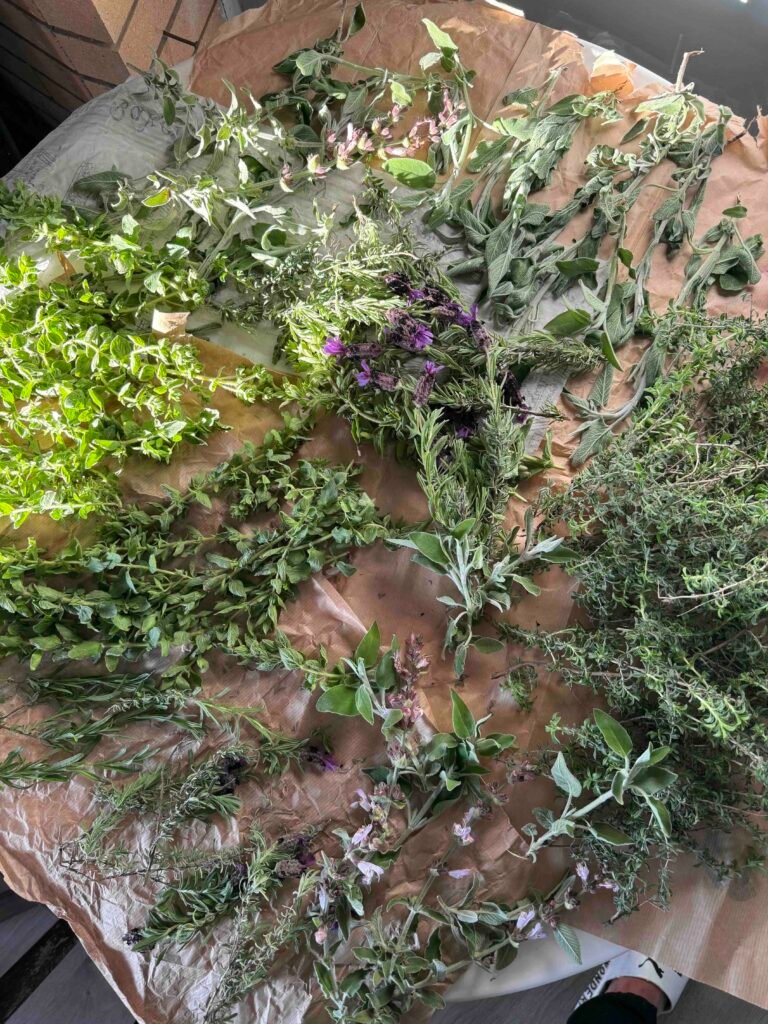
Even though Ikaria is a small island, the types of herbs growing vary from valley to valley. We rented a house in the northern village of Karavostamo, an area especially rich with mountain herbs. However, when we went to the southern side of the island, herbs were still present but far fewer in number compared to the north.
The island’s biological diversity was striking too — in some valleys, only sage and oregano grew, while just a few kilometers away, entirely different herbs could be found and sage was absent altogether.
The nomadic goats eat these herbs — along with plants unpalatable to humans — and this directly influences the flavor and quality of their meat and cheese.
The reason I elected to focus on wild herbs in this study is because they embody a living connection with ancient Greece. The island itself is called “Ikaria,” said to be the setting of the classic myth of Icarus and Daedalus.
From the mountain peaks, which rise several hundred meters above sea level, you can walk to the shore in about twenty minutes, as NF herself did each morning. If you’re on a scooter, it almost feels as if wings have sprouted from your back — the terrain is so steep and open that if you kept riding off a guardrail-less cliff, it would feel as though you could fly straight into the sky and sea, and up closer towards the sun!
In ancient Greece, the properties and effects of medicinal herbs on humans were diligently analyzed. The ancient Greek physician Hippocrates — founder of modern medicine and author of the maxim “Let food be thy medicine, and medicine be thy food” — emphasized the need to harmonize the body’s four humors: blood, phlegm, yellow bile, and black bile.
Some say this humoral theory may have been influenced by India’s Ayurvedic traditions. The ancient Greeks conducted studies to objectively analyze and record how herbs affected the human body.
For example, oregano was believed to have been planted by the goddess Aphrodite in her mountain garden and symbolized happiness. Greek physicians prescribed oregano mixed with honey as a tea to treat and prevent coughs and throat inflammation.
Even the names of herbs reflect the reverence they were given. “Sage,” in English, means “wise person.” In Latin, the same plant is called Salvia, meaning “to save.” “Oregano” comes from the Greek oros (mountain) and ganos (happiness). The word “lavender” derives from the Latin lavare, meaning “to wash.”
Hippocrates himself wrote that lavender “warms and protects the weary brain.” Superstitious ancients also used lavender oil as an ointment, rubbing it on the chest or feet to ward off evil. I myself have been using essential lavender oil (the homemade kind) since I wrote this report, applying it to my beard to ward off evil spirits. It seems to be working!
The Myth of Blue Zones
All of the herbs mentioned above can be brewed into tea, yet I never once saw a local drinking herbal tea. Perhaps it is a custom already lost to time. As for the so-called “centenarians,” the defining feature of Blue Zones — I didn’t meet a single person aged over ninety. The elderly did not seem particularly active either. Longevity may exist, but certainly not to the degree of 100 years being the norm.
When I told several shop owners that we were researching the Blue Zone phenomenon, they laughed and said it was nothing more than publicity — an urban myth. Others claimed that the islanders cunningly avoid reporting the deaths of the elderly in order to continue receiving their pensions fraudulently. If so, it’s possible that Ikaria’s reputation as a land of centenarians was built on bureaucratic fraud rather than biology.
After all, the concept of the “five Blue Zones of the world” has never been clearly defined. No-one seems to know who ranks sixth or seventh in longevity, nor is it clear how rigorous the research methods behind those rankings truly are. It’s also uncertain whether the so-called Blue Zone researchers actually visited every one of the zones themselves. Most likely, the internet exaggerated their findings and created a mythology of its own — a modern folk tale of wellness and paradise.
There is also a surprising amount of misleading information about Ikaria circulating online. For instance, NF found a Russian website claiming that the locals ate plenty of kale and nuts. In reality, no-one here eats kale at all — though they do eat horta, a kind of wild spinach that grows in the mountains — and nut trees do not grow on the island. The locals told us that “Blue Zone” is just marketing, and that modern Ikarians live completely different lives from the older generation. And they are perfectly content, they said, with the comfort that cars, trade, and technology now provide.
***
During our Blue Zone research in Sardinia and Ikaria, we made countless discoveries — of lifestyle, quality of life, geology, and culture. We may now possess an even deeper local understanding than some of the original Blue Zone researchers themselves.
I became convinced that Ikaria’s true treasure lies in its wild herbs, and we went into the mountains to gather them by hand. Being wild, each plant has its own unique scent, even within the same species — as individual as human beings.
Take Ikaria’s oregano, for example. Dried oregano sold in supermarkets has a faint bitterness and is typically sprinkled over pizza or tomatoes for flavor. But the wild oregano of Ikaria carries a subtle sweetness, with the refreshing note of lemon or yuzu.
Ikaria’s herbs can be utilized in many ways — as tea, in baths, to season fish or meat (except lavender), as a spirit infusion, or as essential oil.
Even just inhaling their natural fragrance clears the mind.
The Soap of Ikaria
While traveling through western Turkey on our way to Ikaria, I came across handmade olive-oil soaps — reminiscent of Aleppo soap, which had been a top-selling product on Amazon in Japan when I lived there. Since then, I’ve preferred natural soaps over chemical ones, so I was drawn to local varieties.
On Ikaria, I found the best soap of all in a tiny minimarket: a white, olive-oil-based soap made by the shopkeeper’s father by mixing olive oil and potassium at home. The shop also carried soap from nearby Samos Island. Both Greek varieties were superior in quality to the Turkish ones, though Turkish soaps offered a wider range of fragrances.
The Ikarian soap had a gentle scent that lingered all day, foamed moderately, and was beautifully pleasant to use. Its fragrance was subtle yet noticeable to those nearby, and it clung beautifully to my beard and hair. Hours after washing, I smelled my underarms — they emitted the best scent I have ever encountered from that part of my body!
The effect of the Ikarian soap was remarkable: my skin became lustrous, glowing, and supple without dryness.
Reflections
In my view, the Blue Zone is like many other internet phenomena — a myth that has taken on a life of its own, and drifted away from reality. Ikaria, in truth, is simply a typical small Greek island — and there are hundreds like it. Most tourists (and many of them young women!) come merely to enjoy the quiet beaches, pleasant climate, fresh air, and leisurely walks.
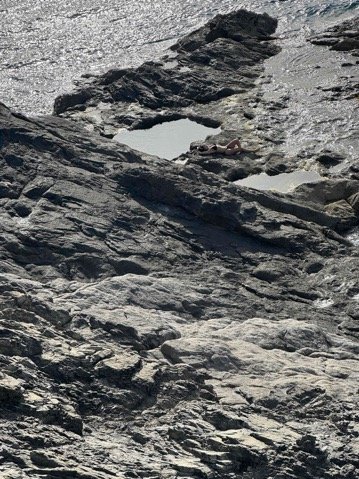
At Nas Beach, a crescent inlet carved from hardened magma, we watched a few young nymphs scale an enormous rock. I alone followed them up. Standing atop the cliff, I looked down at them as they moved freely and joyfully, basking in their beauty and innocence, expressing themselves with reckless abandon.
Protected by the blinding light of the sun behind me, I stole a single photograph from atop the volcanic crag — not out of lust but reverence — like a hooded stranger glimpsing myth made flesh. Then I put the smartphone away and let my eyes do the seeing. Myth, after all, as I know so well, is fiction that longs to become true. And so, the Odyssey, the voyage at the end of the world finally reached the island of Ikaria.
The Blue Zone may be a myth — but a myth with potential. Ikaria’s genuine virtues lie in its olive-oil soaps, wild herbs, and slow rhythm of life.
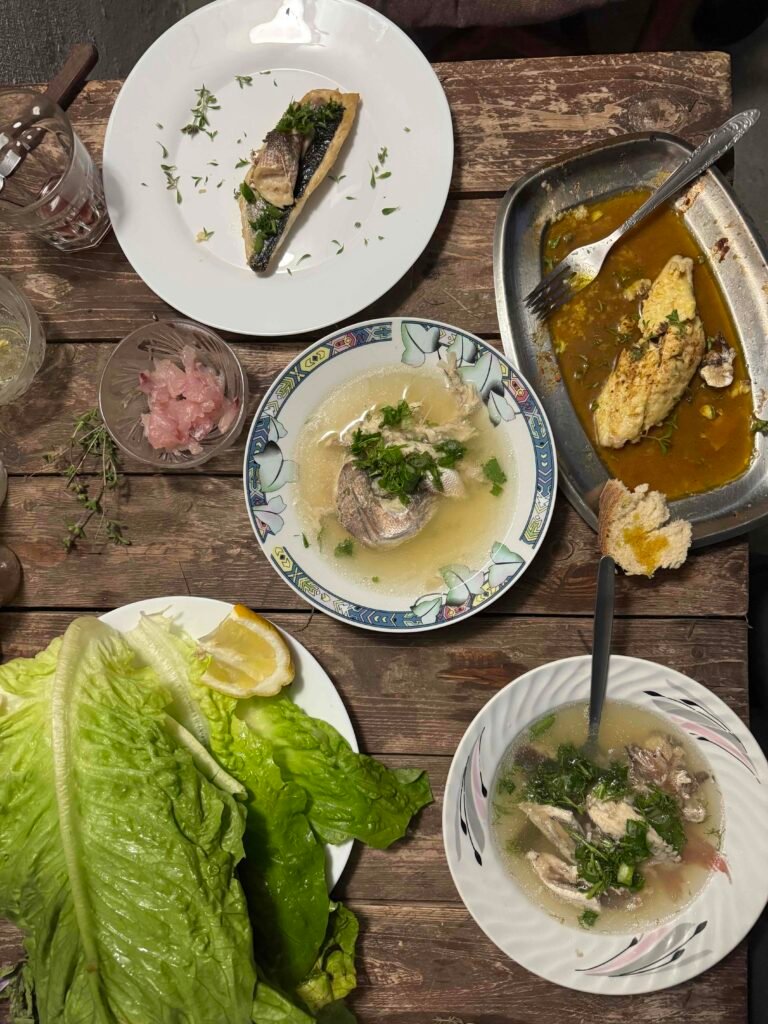
I am sending you the finest soap I have ever used, along with wild thyme, oregano, sage, and lavender. Steep them for five minutes in hot water, and they transform into a mysterious green tea. Sprinkle the thyme or oregano over meat, eggs, or anything else — their exotic fragrance will turn any dish into something ethereal.
Life on Ikaria moves at a pace where all worldly troubles seem to dissolve into irrelevance. One cannot help but slow down, breathe deeply, and gaze in all directions at the island’s world-class scenery. Indeed, there is nothing else to do but enjoy it.
Finally, a word about Ikaria’s pure wine and hot spring salt. The wine is a potion of happiness — if you come to Ikaria, after a couple of glasses, you might find yourself similarly dancing in the streets to the rhythm of local Greek music. And I must send you some of the toxic, radioactive salt I collected from the hot spring — a salt so strong that it made the ones I used before seem impotent by comparison.
End.