
Ayurveda and Eastern Philosophy
It is no exaggeration to call India the birthplace of Eastern culture and philosophy. After all, Buddhism, Hinduism, and the lesser-known but equally historic Jainism all originated here. The entire peninsular subcontinent, hemmed in by the Himalayas and encompassing present-day India, Pakistan, Nepal, Bhutan, and Bangladesh, has long been referred to as “Bharat.” Whether what emerged from Bharat is best defined as religion or philosophy is debatable, but their way of eating, thinking, and living is so unique that it might as well come from another dimension. There is much we can learn from this tradition. The source of the Indians’ child-like cheerfulness and seemingly unstoppable energy – even in harsh economic and natural environments – is their culture.
“Ayurveda” is the traditional medicine of Bharat, distinct from our Western concept of “medicine.” Western medicine tends to view and treat the human body like a predictable machine, grounded in molecular science. Ayurveda, on the other hand, takes a holistic approach, aiming to combine and harmonize bodily elements within a religious and philosophical framework unique to Bharat. Ayurveda and Bharat are inseparable, and this is probably the closest way to understand their concept of “medicine.”
It’s important to note that Indians do not reject Western medicine. In fact, becoming a doctor of Western medicine is considered the highest achievement in terms of status. Therefore, it is crucial to understand that Western medicine and Ayurveda are not mutually exclusive; they coexist and often complement each other. Meanwhile, the burgeoning field of mental health disciplines and its increasing (though, if you ask me, misplaced) importance in the West – such as mindfulness, yoga, and meditation – can be interpreted as Westerners beginning to look eastward for a better understanding of health. Perhaps they are finally starting to realize that the human body is not merely a machine.
Consider the world of “yoga” which, beyond the popular image of stretching exercises, is a Hindu religious philosophy teaching the unity of the universe with the mind, body, and soul. Yoga predates Ayurveda, translating to “life knowledge” rather than “life science” as some claim. It embodies the idea that humans have seven “chakras” or centers of mental and spiritual energy along the spine. The sixth chakra is the “third eye” (called Ajna in Sanskrit), located at the center of the forehead. The sandalwood powder I introduce here is said to directly stimulate the third eye.
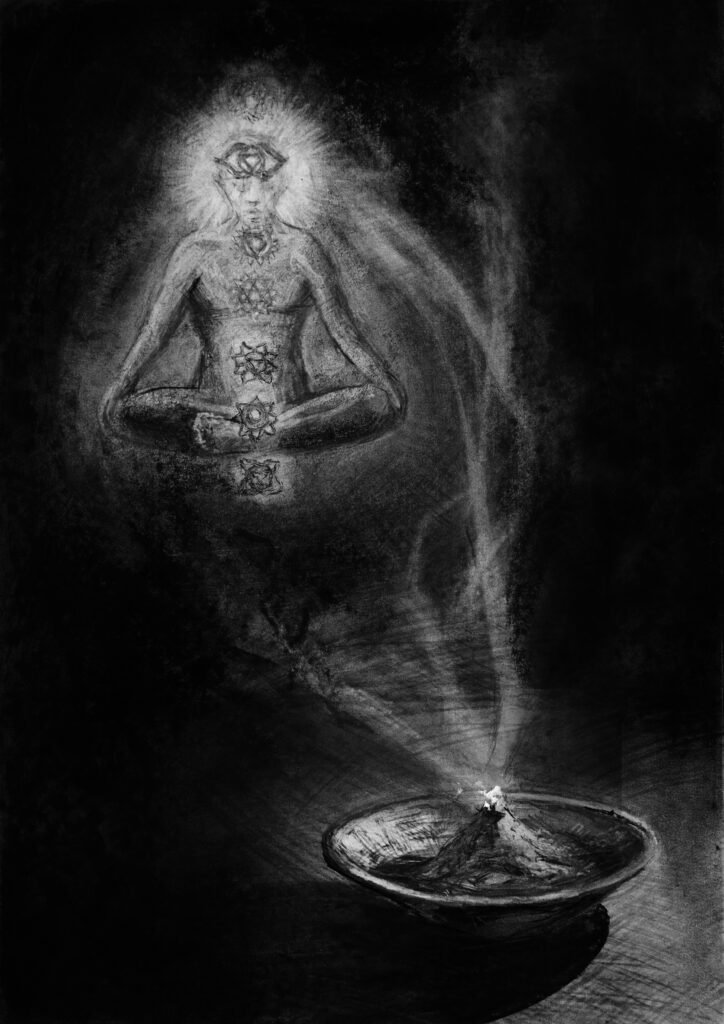
The third eye governs a person’s ability to concentrate and is linked to a duality akin to “yin and yang.” Yin (the Chinese character for yin symbolizes shade or darkness 陰) corresponds to emotions like anger and stress – the frustration felt when life does not meet expectations. Excess yin can be balanced by yang (symbolizing sunlight 陽). Various methods are used to restore balance in favour of yang, such as meditation or bathing in the Ganges River. Sandalwood powder, which is quick and convenient, is said to have a strong yang effect. For this reason, sandalwood is omnipresent at religious ceremonies throughout India, as explained to me by an Ayurvedic practitioner.
Of course, much of this may sound dubious. However, if you think of burning sandalwood as a way to “switch your mind on” many will agree that improving concentration is essential in our distracted modern lives. Television, smartphones, social media, and other distractions are all designed to rob us of our attention and focus. Such distractions are framed as a kind of “illusion” within Eastern philosophy, and anything that can protect our minds and help us regain possession of our focus amidst the multitude of worldly illusions is valuable and much-needed. The mysterious, gentle scent of sandalwood has been relied upon for thousands of years – and today, it feels more essential than ever. However, sandalwood is ineffective unless you first understand, to some extent, the Eastern philosophy that underpins it (i.e., its context) and embrace its rationale before use.
Sandalwood powder is piled on a small saucer, lit, and then the flame is extinguished, allowing it to smolder as embers. The embers will continue to burn for several minutes, filling the room with fragrant smoke that enhances concentration. Whether meditating, studying, or simply working, a space filled with sandalwood smoke can help transform a negative mind into a positive one.
(Incidentally, I am writing this in a room where sandalwood has been burning. After a week of regular use, I found it effective in changing my mood and focus – and have come to rely on it. However, this was only possible because I spent a lot of time learning about Ayurveda and the philosophy behind it. Without that background knowledge, I doubt it would have been half as effective – there are no shortcuts.)
Next, I would like to discuss rose water, a fragrant liquid distilled from rose petals.
Rose water has a variety of uses in India. Ayurvedic practitioners recommend placing a drop in your eyes before bed, promising that your eyes will feel refreshed when you wake. When applied to the face, rose water is said to impart a radiant glow to the skin.
As an experiment, I applied rose water to just one eye before sleeping. When I woke up, the treated eye felt refreshed for two whole days. Rose water is gentle, does not sting, and carries a soothing scent that no chemical products can replicate – so I had no resistance to it.
To apply it to the face, mix a small amount of sandalwood powder, milk, a pinch of turmeric, and rose water in a dish and stir well. Apply the mixture to your face and allow it to dry for 5-10 minutes. Rinse with water afterwards, and your skin will feel smooth and cool.
The practitioner also mentioned that adding a few drops of rose water to drinking water improves digestion.
Rose water has been used for thousands of years in this part of the world (between Persia and India) and remains one of the core ingredients in Ayurveda. It’s also used in sweets; for example, a few drops in yogurt will impart a lovely floral aroma. Since rose water is fragile, it is always added at the very end, without heating, of course.
In Eastern philosophy, the rose is closely linked to the fourth chakra, the heart chakra called “Anahata” which means “pure” or “unharmed” in Sanskrit. This chakra governs powerful emotions – primarily love, fear, and hatred. These emotions cycle through prominence, taking turns to come to the fore depending on life’s circumstances. For example, when you are feeling absolute love, fear and hatred recede but do not vanish completely; they remain in the background, dormant. Depending on a person’s circumstances at the time, hatred or fear may be emphasized. Each emotion is ever-present and emphasized according to the balance of the whole. When the balance is out of equilibrium, the chakra is “blocked”, making it difficult to build or maintain healthy relationships with others, society, and the world. Therefore, Ayurveda emphasizes nurturing the balance of the fourth chakra. When handled well, this chakra governs the potential energy of human will and directs its flow. Under its influence, imagination and dreams crystallize into vision and determination.
It’s important to note that in Eastern philosophy, excessive emotion is generally viewed negatively. However, a crucial distinction exists between the emotion itself and the intent that drives action:
1) Actions based on passion (Raja-guna)
2) Actions performed with passion (Sattva-guna)
Though both relate to passion, they represent fundamentally different modes of behaviour. In Hindu scripture – the Bhagavad Gita – a conversation is recorded between Lord Krishna and the hero Arjuna, who appears to Arjuna as his friend. They ride a chariot together between two armies facing off in the lead-up to the Battle of Kuruksetra. Lord Krishna explains various morals to the hesitant Arjuna, who is afraid of going into battle to fight his opponents – the battle was an internecine conflict against Arjuna’s family and friends. Lord Krishna clarifies the differences between these emotions:
1) Those attached to their actions and their outcomes – craving material enjoyment, prone to jealousy, impurity and influenced by pain and pleasure – they are acting in the mode of passion (Raja-guna).
2) Those free from the material modes, without false ego, who perform their duties with determination and enthusiasm – unmoved by success or failure – act in the mode of goodness (Sattva-guna).
The way I interpret the Hindu teaching here is to be mindful of one’s unity with the universe and to purify the intention behind every action – whatever it may be (called karma). In practical terms, Arjuna must fight; his emotions should be in perfect balance and equanimity, not interfering with the performance of his duty to fight. Humans are vulnerable to their base emotions, and when motivation stems from carnal desires – excessive love, fear, or hatred – one is said to be acting in the mode of passion, which is inferior to the mode of goodness. According to Hindu cosmology, a life lived solely through actions taken in the mode of passion traps the soul in the never-ending cycle of birth and rebirth – unable to escape the misery of this world. Conversely, actions rooted in the mode of goodness generate positive karma (and results!), ultimately leading to true liberation from this world, possibly reaching Nirvana – oneness with God.
Thus, rose water and other Ayurvedically correct substances are said to promote the mode of goodness, while things like onions (which increase excessive sexual desire) and garlic (which dulls the mind), and of course, drugs, fall into the mode of passion – or even the mode of ignorance (to be explained later).
The same Ayurvedic principles apply to various food items and their consumption. One day, an Indian police officer asked me: “What do you think of Indian cuisine?” My answer was:
“Indian cuisine is incredibly profound. If you evaluate it merely on the surface – i.e., whether it’s tasty or not – without understanding the underlying philosophy and the effect of the foods you’re consuming, you won’t grasp the true essence of Indian cuisine.”
Since April 2024, I’ve broadly followed a so-called Hindu diet. It contains no meat or fish, and no onions or garlic. It is not a vegan diet; I consume dairy products like cheese, and take milk in chai, as well as eggs. The Bhagavad Gita discusses food and its qualities, categorizing them into three types:
1. Sattvic (Balanced, pure, and peaceful food)
This refers to foods that embody virtue. The idea is that food is not consumed for enjoyment but as a means to provide the body with pure necessities – fresh, and without harming other living beings. Meals served at meditation centers and monasteries to monks are entirely sattvic. Flavours are bland, meals are unsatisfying, and offer little pleasure. But this is the point: such food calms the body and mind and assists in tempering the appetite for stimulation. Only fresh food is considered Sattvic. Cooking is minimal; if the ingredient is overcooked, or sits for too long, it loses its vitality and numbs the senses.
Examples: rice, grains, fresh milk and dairy products, legumes, fruits, seeds.
2. Rajasic (Flavourful, stimulating food)
This refers to foods that stimulate passion. Rajasic foods energize the body and mind, sometimes excessively, making one prone to anger and excitement. They are characterized by strong flavours – what is commonly considered “delicious” in modern vernacular. Excessive seasoning and spices also make food rajasic.
Examples: fried foods, cream, chocolate, chili, ginger, jam.
3. Tamasic (Food obtained by harming living beings)
This refers to food associated with ignorance. Tamasic foods weigh down the body and dull the mind. They include actively harmful ingredients or foods obtained through the suffering of other living beings. These foods burden digestion and often cause post-meal fatigue. If you feel sleepy after eating, you’ve likely consumed tamasic food. Old food is also considered tamasic because it has completely lost its vitality.
Examples: meat, fish, garlic, onions, tobacco, alcohol, drugs, canned foods, frozen foods, junk food, artificial seasonings, white sugar.
The Bhagavad Gita teaches that it is better not to eat anything that has not first been offered to God. Garlic and onions, though botanically vegetables, are traditionally excluded from such offerings. The reason lies not in superstition but in the powerful effects they have on the body and mind. Garlic is believed to dull mental clarity. In the West, even as early as the 1950s, studies suggested that garlic could slow reflexes by a factor of three. Military pilots were reportedly advised to avoid garlic for 72 hours before flying. Onions, on the other hand, are said to overstimulate sexual desire. In Ayurveda, any substance that strongly alters the mental or physical state is considered tamasic – that is, clouding, heavy, and associated with ignorance.
That said, Ayurveda does not issue blanket prohibitions. Rather, it offers a flexible system to help find balance according to your needs. With proper knowledge, one can adapt their diet to suit their constitution, lifestyle, environment, and profession. For example, a monk should only consume sattvic foods – pure, light, and neutral – while a laborer might require energizing rajasic foods to keep going, while minimizing tamasic intake like alcohol to stay healthy. Athletes might even need to incorporate tamasic elements like sports drinks for temporary performance gains. Ayurveda is not dogma; it is discernment.

These dietary categories serve as guidelines to help us engage with food more consciously. Eating only what is delicious without consideration is an act of ignorance. Even worse, knowing better and still doing the same reflects a deeper kind of ignorance. True Ayurvedic wisdom lies in understanding the qualities of each ingredient and using food intentionally, not simply for flavour or what nutritional “scientists” say.
In the modern world, avoiding tamasic foods can be difficult. Take Japan, for example. Due to regulations requiring all dairy to be pasteurized, truly fresh dairy – an important sattvic ingredient – is hard to come by. As a result, following a complete sattvic diet according to Hindu (and therefore Indian) discipline is impractical outside of India. On the other hand, good tofu and fresh fish are plentiful in Japan. Ayurveda forces us to think about how to manage our consumption outside the confines of India and greater Bharat. In my own interpretation, I have chosen to categorize fresh fish as rajasic rather than tamasic – the distinction lying in the vitality of the ingredient. Fresh fish contains prana, or life force, while old, lifeless meat or fish is dead and truly tamasic.
This distinction is easily understood through sushi. Freshly prepared sushi, made from high-quality market fish and prepared by a conscientious chef, can be rajasic – stimulating but clean and vital. In contrast, sushi made from frozen or low-grade farmed fish, laden with additives and preservatives, falls squarely into the tamasic category. To equate the two – fresh sushi served at a proper bar versus mass-produced conveyor belt sushi – is not just a misunderstanding; it is an act of ignorant dogma. We must think for ourselves – using our minds rather than relying solely on our more gullible taste buds or eyes. We should not blindly trust teachers and profiteers claiming to speak for Ayurveda.
Ultimately, true Indian cuisine will always center around fresh vegetables. This is not only due to religious taboos but also because freshness, vitality, and purity are essential pillars of the philosophy underpinning Ayurveda. These values are rooted in the worldview emanating from Bharat, where life is understood not merely in material terms but as a balance between seen and unseen forces, unmistakably Indian. Ayurveda, too, is Bharat-centric in origin and spirit, arising from the land, climate, and rhythms of life distinct to this region.
All this builds towards an ideal spiritual and psychological outcome. “Attachment” (called upādāna) is said to be the root of all desires. Unfulfilled worldly desires – those to which the passionate or ignorant person binds themselves – cause endless suffering, carrying over from this life to the next. This is the core misery of existence. Its opposite, “non-attachment” (called anupādāna or aparigraha), is a fundamental virtue and one of the five vows taken by Hindu and Jain ascetics. Through non-attachment, they renounce this world – freeing themselves from material ties and desires, letting go of base impulses such as our hunger for taste – culminating in a final fast unto death – Sallekhana. This path, followed by a select few monks and serious meditators, demands ultimate discipline and asceticism.
Unsurprisingly, religious ascetics must exercise total control over their emotions. Regulation of the fourth chakra is key to maintaining its delicate equilibrium at all times. In this way, Ayurveda and Hinduism are deeply interwoven systems. Even so, Ayurvedic knowledge is valuable not only for ascetics but also for casual users – those who wish to control their inner energies wisely. Yet, paradoxically, it only truly benefits those willing to transcend behaviour rooted in the mode of passion – that is, the ego.
***